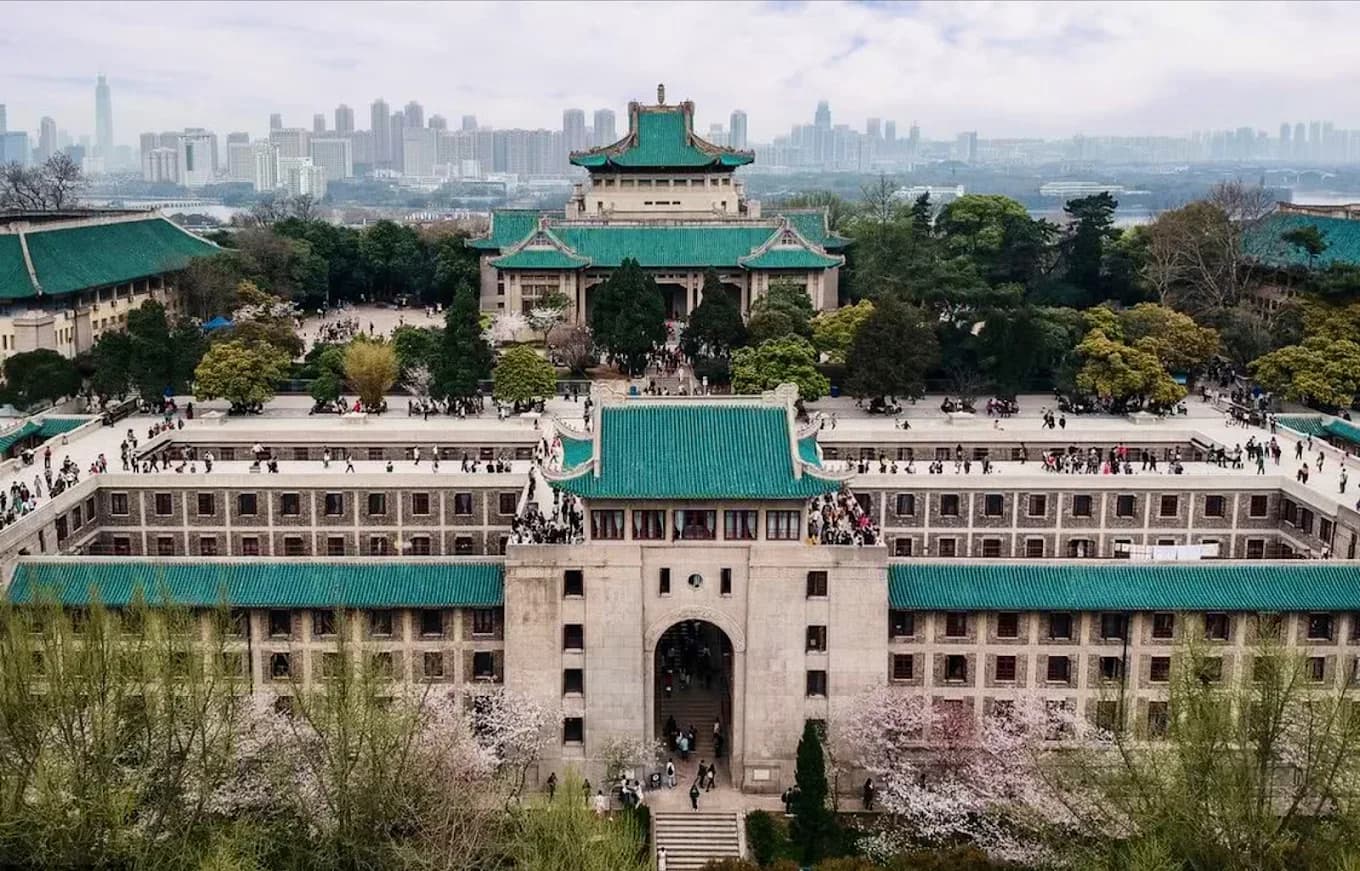
Hohai University in Nanjing is China's specialist university for water resources and hydraulic engineering, and it takes a substantial international cohort. Its published thesis rules are a mix: a detailed formatting standard from 2020, a genuinely useful bilingual handbook for international graduate students, and procedural regulations that are older than students often realise.
The terms you will search under: your thesis is a 学位论文 (xuéwèi lùnwén, degree thesis), the similarity check is 查重 (chá chóng), reported as a 总文字复制比 (total text duplication ratio), anonymous external review is 盲审 (mángshěn), and the oral defence is 答辩 (dábiàn), before an 答辩委员会 (defence committee).
The law changed on 1 January 2025
The 学位法 (Academic Degrees Law) took effect on 1 January 2025 and repealed the 1980 学位条例. Article 37 lets a university refuse or revoke a degree where the thesis involves ghostwriting, plagiarism or fabrication, including after the degree has been awarded. Article 40 gives you a right to 学术复核 (academic review) where you dispute an academic evaluation, and the university must reconvene experts and decide within 30 days. Article 44 confirms that overseas applicants are awarded degrees under the same requirements and procedures as everyone else.
Any Hohai guidance that cites only the 学位条例, including some documents linked below, predates this law. The procedures in them are still the working process, but the misconduct and appeal framework on top of them is now the 学位法.
查重: the bands, and a caveat about them
A Graduate School notice on handling master's thesis similarity results, reproduced by Hohai schools, sets four bands on the total duplication ratio:
| Total duplication ratio | What happens |
|---|---|
| ≤ 15% | Submit directly for review and defence |
| 15% to 30% | Revise carefully, at least two weeks before resubmitting |
| 30% to 40% | Substantial revision over one month, with supervisor and school approval before resubmitting |
| > 40% | Major rework over three months, with supervisor and school review before resubmitting |
The same notice is explicit that a detection result is reference value only and cannot on its own decide the outcome. Your supervisor reads the report and forms a view, your school runs the checking and keeps the records, and the Graduate School can spot-check at the point of degree conferral.
Two honest caveats. This notice is several years old, and the publicly reachable copies are on school sites forwarding it rather than on the Graduate School's own pages. The 15% figure is repeated in recent school-level submission notices, which is reassuring but not the same as a current university-wide publication. Ask your school for the current band in writing before you submit.
Review: how many people read it, and what they can say
Doctoral
The doctoral thesis work management measures set out a three-part pre-review, complete at least three months before your planned defence: supervisor initial review, a 预答辩 (pre-defence) chaired by your supervisor with at least five professors present, and a format check. Blind review materials then go to the Graduate School degree office at least 60 days before the planned defence, or 100 days for a classified thesis.
Review is anonymous in both directions. The Graduate School appoints at least three external experts qualified to supervise doctoral students, none of them connected to you. You and your supervisor may name institutions or people to be avoided, up to one institution or two individuals. Review takes at least 30 working days, or 60 working days for a classified thesis, and four verdicts are possible:
| Verdict | Meaning |
|---|---|
| 达到,同意组织答辩 | Standard met, defence may be organised |
| 总体达到,略作修改后组织答辩 | Broadly met, minor revisions then defence |
| 基本达到,需重大修改后再送审 | Objection. Major revision, resubmit for review |
| 尚未达到,不同意组织答辩 | Objection. Standard not met, defence refused |
The last two count as objections (异议), and the response scales: one objection means the defence is deferred for three months of revision before re-evaluation; two or more objections with at most one refusal means six months; two or more refusals means comprehensive revision over at least one year.
Where your school judges the revised thesis has reached doctoral standard, the Graduate School sends it to two further external experts. The re-evaluation in principle goes back to the experts who objected, except where an appeal is running.
Master's
The English text in the international student handbook sets out the master's process. Two reviewers with senior qualifications are appointed, one from outside the university, excluding anyone from the defence committee or your own college. If your discipline can award doctorates itself, the external reviewer is not compulsory. Reviewers are proposed by your supervisor and approved by the college, and your supervisor cannot be a reviewer. Their names and comments are confidential to you, though their questions may be passed to you the day before the defence.
The regular review period is at least 7 days, or at least 40 working days for a classified thesis. Pre-defence materials go to the college at least one month before the expected defence, or two months for a classified thesis. If one reviewer says the thesis has not reached master's standard, the college appoints additional reviewers. If two say so, no defence can be organised.
The defence
Hohai's English procedural note is direct about anonymising your submission: hide your name and student number on the cover and title pages, delete the acknowledgements entirely, and leave the discipline name and thesis title visible. Submit a PDF with the required file naming, plus the information sheet, two copies of the defence application, a format examination form signed by your supervisor, and copies of published papers with retrieval reports.
| Committee | Composition | Supervisor as a member |
|---|---|---|
| Doctoral, 7 | At least 2 internal and 2 external experts; chair a professor or equivalent; external experts' institutions should award doctorates | May be one member |
| Doctoral, 5 | As above, at most 1 member who is not a doctoral supervisor | May not |
| Master's, 5 | Senior-qualified experts or master's supervisors; internal reviewers should be members; external experts involved | May be one member |
| Master's, 3 | As above | May not |
Every committee has a secretary at lecturer rank or above, or holding a doctorate. The committee votes by secret ballot on both passing the defence and recommending the degree, and two-thirds or more of all members must agree.
Defences are held publicly on working days, never during national holidays or the winter and summer vacations. A classified thesis approved by the secrecy committee may be defended non-publicly.
If you fail but the committee believes the thesis can be revised, it can resolve that you revise and re-defend once within two years. If it makes no such resolution, the application lapses. A doctoral committee that judges the work below doctoral but at master's standard can recommend a master's degree instead, where you do not already hold one.
Doctoral review normally completes within about 60 days, and defence approval takes around three working days. Applications are received at the degree office on set days and hours each week.
Formatting, concretely
From the formatting standard, which governs doctoral theses and which master's theses follow:
| Item | Requirement |
|---|---|
| Paper | White, A4 (210 mm × 297 mm) |
| Margins | At least 25 mm top and left, at least 20 mm bottom and right |
| Printing | Double-sided except the front matter; main text starts on a right-hand page; each chapter starts on a new page |
| Binding | Not with staples; the spine carries the title, author and university name |
| Title | Generally no more than 30 characters; the foreign-language title no more than 20 content words |
| Chinese abstract | Generally no more than 1,000 characters, with the English abstract identical in content |
| Keywords | 3 to 8, at the lower left of the abstract, with matching English keywords |
| Numbering | Chapters as 第一章; sections below in Arabic numerals, 1.1, 1.1.1 |
| References | Sequential numeric coding in order of first citation |
| Units | The statutory units of measurement of the PRC, in international symbols |
The required order is front matter (cover, title page, declaration and authorisation, foreword, Chinese and English abstracts, keywords, contents, lists of figures and tables where needed, notation table), then the body (introduction as chapter one, main text, conclusions, acknowledgements, references), then appendices. The title page must be a right-hand page and must additionally carry the foreign-language title, the thesis language, the abstract language, your student number and the page count. Templates and examples are on the Graduate School's format page and its forms and downloads area.
Rules that apply only to international students
Hohai issues a bilingual Thesis Handbook for International Graduate Student, and two things in it are not in the general rules.
The schedule is enforced. You agree a study plan and working schedule with your supervisor. Each stage's task cannot be completed more than one week after the agreed time, or it counts as "breaking the rules". Three violations and you are treated as having abandoned the thesis and defence, deferred to the following cohort, and liable for tuition and accommodation fees again. Very few universities put this in writing. Hohai does.
Publication requirements differ. International master's candidates have no explicit publication requirement, although publication is encouraged. International doctoral candidates do have one, and it splits by native language. Native English speakers face the same conditions as Chinese students, which for science and engineering means at least one paper in a foreign-language journal indexed in SCI. Non-native English speakers face a separate list of options, for example two EI-indexed papers, or one EI-indexed paper plus two in indexed Chinese or overseas journals.
This handbook is the 2019 edition and rests on the 2011 thesis management measures. National policy on hard publication requirements has moved since then. Treat these as the last published position rather than the current one, and get the current requirement in writing before you plan around it.
Hohai also sets a reading requirement for doctoral candidates: at least 80 sources, of which at least half must be foreign-language.
What Hohai does not publish clearly
Being honest about the gaps is more useful than filling them in:
- The current similarity threshold. The 15% band is well attested across school-level notices, but I could not find a current, university-wide publication of it on the Graduate School's own site. Ask your school.
- An embargo route for ordinary theses. Hohai publishes a 涉密 (classified) process, applied for before the proposal stage and approved by the university secrecy committee, with the level and period set by the research project. What is not published is a general 延迟公开 option for a non-classified thesis you simply want kept off databases for a while. Ask the degree office.
- What happens after a national 学位论文抽检. Hohai has a master's thesis spot-check management measure, but the copy I could reach was not readable. Post-award spot-checking by the Ministry of Education and provincial authorities applies to Hohai as to everyone, and can lead to revocation under Article 37 of the 学位法. The university-specific consequences are the part to ask about.
- The current international student handbook. The copy on the International Education College site is restricted to the campus network. The copy linked here is reachable from outside but is the 2019 edition.
Each of those is a question to put to a named office rather than a gap to guess at.
Pre-submission checklist
- Current similarity band confirmed with my school in writing, and my ratio below it
- A4, 25 mm top and left margins, 20 mm bottom and right
- Title within 30 characters, foreign title within 20 content words
- Chinese abstract within 1,000 characters, English abstract identical in content
- 3 to 8 keywords, with matching English keywords
- Name, student number and acknowledgements removed from the review copy
- Doctoral: pre-review three months out, blind review materials 60 days out
- Master's: pre-defence materials to the college one month out
- Publication requirement confirmed for my degree and my status
- Bound without staples, spine carries title, author and university
- International students: working schedule signed and no stage more than a week late
Where to ask
Your supervisor and your college come first for scope and methodology. The Graduate School degree office handles review submission, defence approval and the forms, and publishes its receiving hours. The International Education College is the right place for handbook, language and schedule questions.
If the writing rather than the procedure is the problem, our thesis writing support works chapter by chapter, and we also help with the research paper you may need alongside it.
This guide is independent. We are not affiliated with, endorsed by or partnered with Hohai University.