
10 Professional Tips to Write a Thesis Like an Expert
Written by The Mythesisbuddy Team · Published August 15, 2026 · 7 min read
Writing a thesis is one of the most demanding parts of a university degree. It asks you to manage a long research project, make defensible decisions, and present your findings in a clear academic form. Strong theses are rarely produced through inspiration alone. They are built through planning, consistent work, careful analysis, and repeated revision.
The following practical tips can help you approach thesis writing with greater structure and confidence.
1. Start With Your University's Official Guidelines
Before drafting anything, locate the current thesis handbook, formatting manual, submission checklist, and any faculty-specific instructions supplied by your university.
Check requirements such as:
- Required chapters or sections
- Word or page limits
- Font, spacing, and margin rules
- Page numbering
- Citation style
- Title-page wording
- Tables and figures
- File format and naming
- Electronic or printed submission procedures
Requirements may differ between faculties, programs, and degree levels. When two documents appear to conflict, ask your supervisor or graduate office which instruction takes priority.
Professional habit: Create a one-page compliance checklist and keep it beside your writing plan.
2. Choose a Focused and Researchable Topic
A good topic is academically relevant, sufficiently focused, supported by available evidence, and realistic within your time and resources.
Before committing to a topic, ask:
- What problem will this research examine?
- Why does that problem matter?
- What is already known?
- What gap or unresolved issue can the study address?
- Can the necessary evidence or data be accessed?
- Can the project be completed within the deadline?
A topic such as "social media and education" is too broad. A narrower topic that defines the population, setting, platform, and outcome creates a more manageable research project.

3. Turn the Topic Into a Clear Research Question
Your research question gives the thesis direction. It influences the literature you review, the methodology you select, the data you collect, and the conclusions you can reasonably draw.
A useful research question should be:
- Clear
- Focused
- Researchable
- Relevant to the discipline
- Answerable with the selected methodology
Do not continue drafting if the research question remains vague. Discuss it with your supervisor and refine it until the scope is clear.
4. Build a Detailed Thesis Outline
An outline prevents the thesis from becoming a collection of disconnected sections. Map the argument before trying to perfect the wording.
A typical outline may include:
- Introduction
- Literature Review
- Methodology
- Results or Findings
- Discussion
- Conclusion
- References
- Appendices
Under each chapter, add its purpose, key questions, main claims, and supporting evidence. The exact structure must follow your university and discipline.
5. Research Systematically
Use peer-reviewed journal articles, scholarly books, official publications, credible datasets, and reputable academic databases. Search with planned keywords rather than collecting sources randomly.
For each source, record:
- Full citation details
- Main argument
- Methodology
- Relevant findings
- Limitations
- How it relates to your research question
This transforms reading into analysis and makes the literature review easier to write. It also prevents the common problem of remembering a useful idea but losing its source.
6. Write on a Consistent Schedule
Waiting for a full free day often leads to delay. Short, regular writing sessions are usually more productive.
Set measurable goals such as:
- Draft 300 words.
- Analyze one table.
- Summarize three sources.
- Revise one subsection.
- Correct ten references.
Track outputs rather than only hours. A realistic weekly plan should include research, writing, revision, supervisor feedback, and unexpected delays.
7. Use Evidence to Build an Argument
A thesis does more than report information. It makes a reasoned argument supported by evidence.
Each analytical paragraph should usually:
- Present one clear point.
- Introduce relevant evidence.
- Explain what the evidence means.
- Connect the interpretation to the research question.
- Link logically to the next point.
Avoid dropping a quotation or statistic into a paragraph without explaining its significance. Your analysis—not the source alone—should move the argument forward.
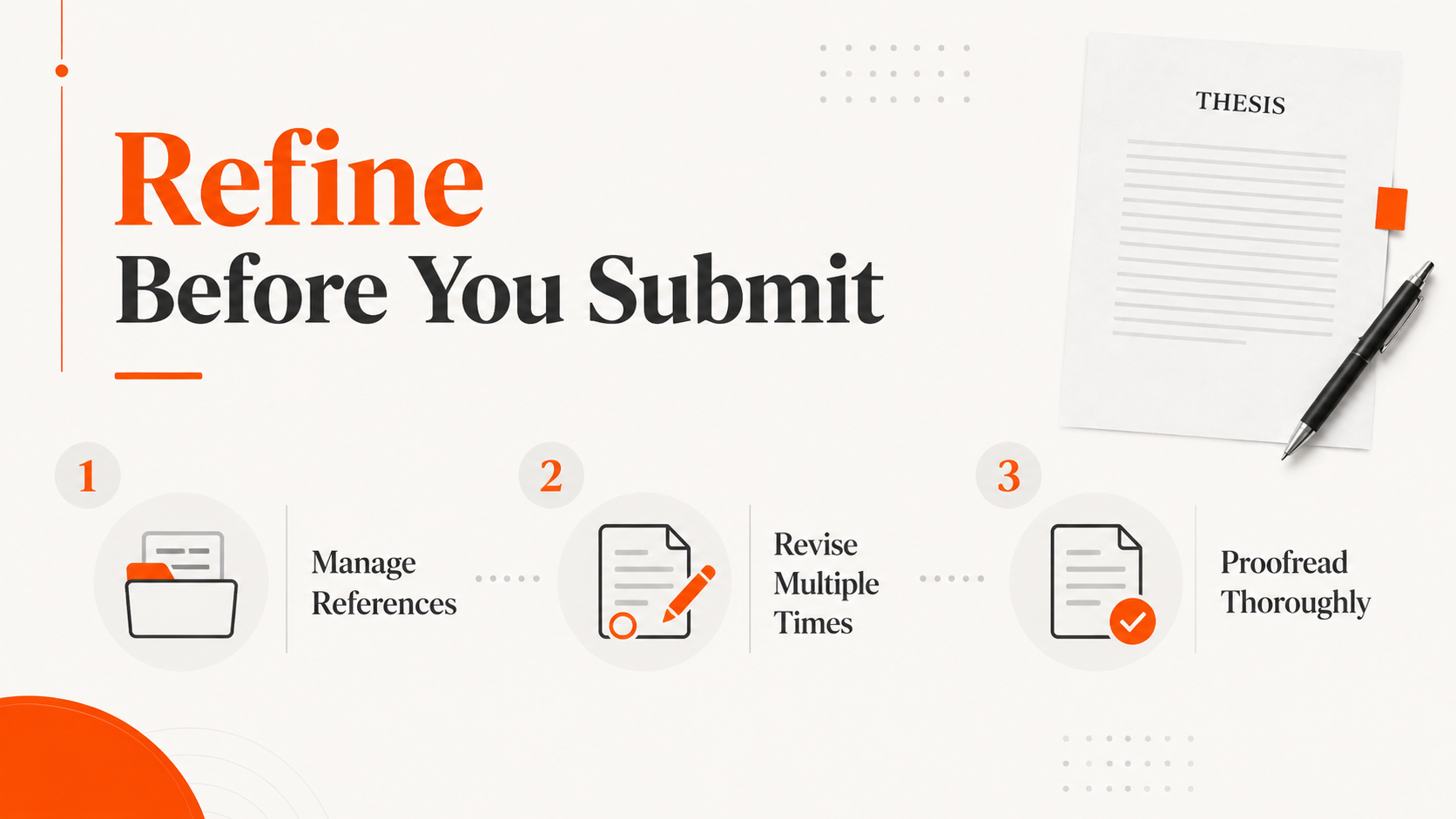
8. Manage Citations From the Beginning
Use a reference manager such as Zotero, Mendeley, or EndNote if it suits your university's workflow. Store complete source information as soon as you begin reading.
Reference software can reduce repetitive work, but it does not guarantee accuracy. Before submission, verify:
- Every in-text citation appears in the reference list.
- Every reference-list entry is cited in the thesis.
- Names, dates, titles, and identifiers are correct.
- One citation style is applied consistently.
- Page numbers are included where required.
9. Revise in Separate Rounds
Trying to fix every problem at once is inefficient. Use focused revision rounds.
Round 1: Argument and Structure
Check whether every chapter has a clear purpose and contributes to the research question.
Round 2: Evidence and Analysis
Confirm that claims are supported and interpretations do not go beyond the evidence.
Round 3: Paragraph and Sentence Clarity
Remove repetition, improve transitions, and simplify unclear sentences.
Round 4: Formatting and References
Check headings, tables, figures, citations, page numbers, and university requirements.
Round 5: Final Proofreading
Correct grammar, spelling, punctuation, labels, cross-references, and typographical errors.
10. Use Feedback Strategically
Ask your supervisor specific questions instead of requesting general feedback. For example:
- Is the research question sufficiently focused?
- Does the methodology answer the question?
- Is the discussion interpreting the findings deeply enough?
- Which section needs the most revision?
Record feedback in a revision log with three columns: comment, action required, and completion status. You do not need to accept every suggestion without thought, but you should understand and respond to each important comment.
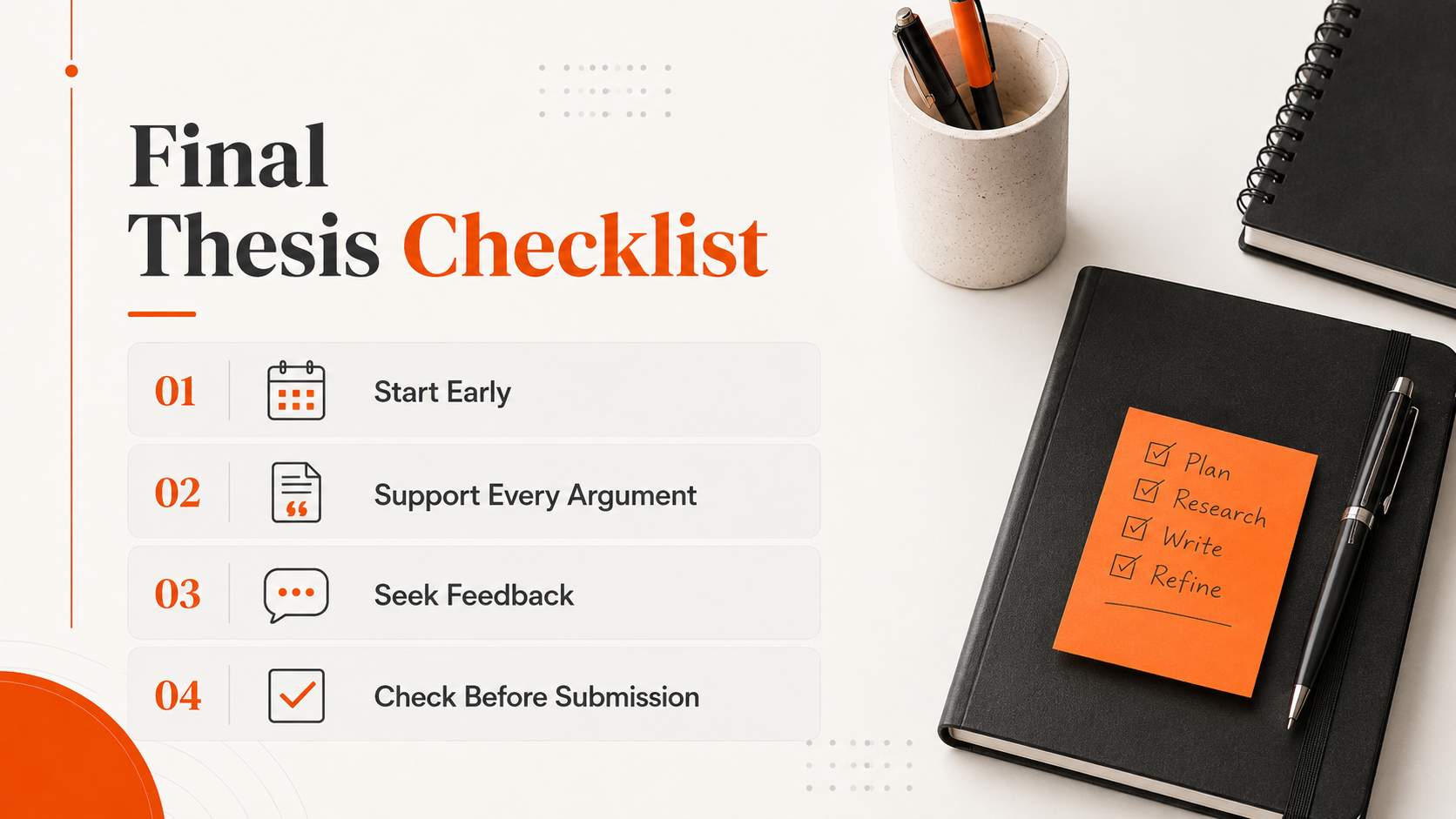
A Professional Thesis-Writing Checklist
- I am using the latest official university guidelines.
- My research question is clear and researchable.
- Every chapter has a defined purpose.
- Important claims are supported by credible evidence.
- My methodology aligns with the research question.
- Citations and references are complete and consistent.
- Tables and figures are numbered, titled, and discussed.
- I have revised the argument, not only the grammar.
- I have backed up all drafts and research data.
- I have completed a final submission check.
Conclusion
Professional thesis writing is a disciplined process. A clear question, realistic plan, credible evidence, consistent writing routine, and careful revision will do more for your final work than last-minute intensity. Start with the requirements, make each chapter serve the research objective, and give yourself enough time to think as well as write.
Key Takeaways
- Begin with official university requirements.
- Narrow the topic before investing heavily in research.
- Build the thesis around a clear research question.
- Plan chapters and arguments before polishing sentences.
- Write consistently and revise in focused rounds.
- Treat citation management and proofreading as part of the research process.
- Ask for feedback early enough to act on it.
Frequently Asked Questions
Written by The Mythesisbuddy Team
Our academics write and review every article — see Our Team for how we protect their privacy and yours.
Related articles

How to Plan, Research, and Write a Thesis Step by Step
A thesis is easier to manage as a sequence of decisions rather than one overwhelming task. A fifteen-step framework for moving from an initial idea to a submission-ready document.
The Mythesisbuddy Team · August 25, 2026 · 7 min read
Common Thesis Writing Mistakes Students Should Avoid
Most thesis problems come from unclear scope, weak planning, and rushed revision — not a lack of ability. Fifteen common mistakes to recognize early, and how to avoid each one.
The Mythesisbuddy Team · August 5, 2026 · 6 min read
Working on your thesis?
Explore our thesis writing service to learn about the process, pricing, and available support — or message us directly with your requirements.