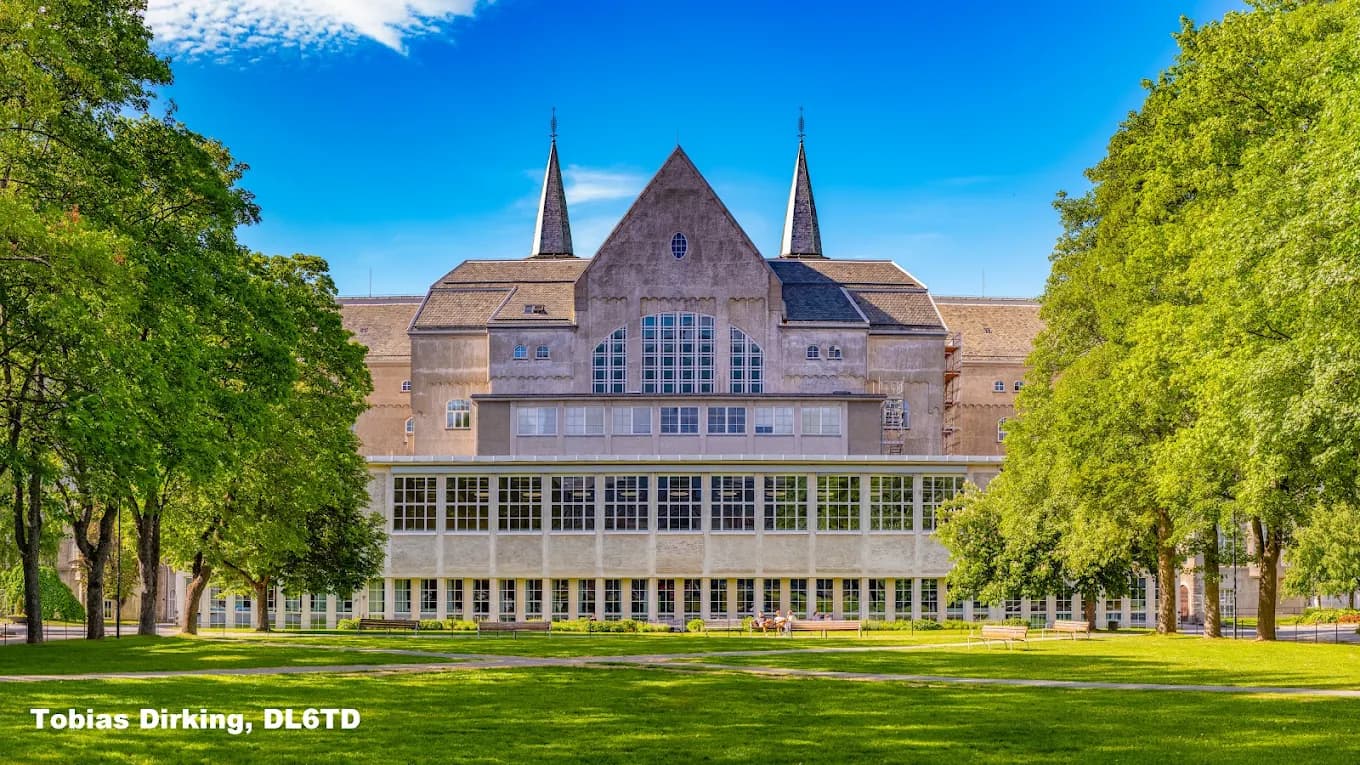

Bergen follows the Norwegian model set out in our NTNU guide: three years, a training component of at least 30 ECTS, a trial lecture on an assigned topic, and a public disputation.
What sets Bergen apart is how precisely the closing stage is timetabled, and how seriously it takes examiner independence.
The countdown, counted backwards
Bergen publishes the whole end of the doctorate as a sequence of deadlines measured back from the defence date.
| When | What happens |
|---|---|
| 12 weeks before | Application for assessment submitted |
| 9 weeks before | Faculty appoints the assessment committee |
| Within 5 weeks of receiving the thesis | Committee submits its recommendation |
| 4 weeks before | Committee recommendation due at the latest |
| 3 weeks before | Norwegian press release drafted |
| 2 weeks before | Thesis made publicly available |
| 10 working days before | Faculty announces the time and place of the defence |
| 10 working days before the lecture | Trial lecture topic announced |
The entire assessment process should normally take no more than five months from submission to public defence.
The holiday buffers
This is the detail most worth acting on, and it is easy to miss:
Four extra weeks if submitting between 20 June and 15 August. Two extra weeks between 10 December and 4 January.
Norwegian academic life genuinely stops over the summer. July is not a month in which committees are appointed or theses are read. If your funding ends in September and you were planning to submit in late June on a twelve-week count, you need sixteen weeks, and the difference is a month of salary.
Plan your submission date around these windows rather than discovering them afterwards.
Two committees, not one
Bergen separates work that NTNU and Oslo combine:
- An evaluation committee, responsible for assessing the thesis
- A trial lecture committee, responsible for assessing the trial lecture
The trial lecture committee consists of at least three members with both genders represented.
The practical effect is that the people judging your thesis are not necessarily the people judging your lecture, which reinforces the point made at every Norwegian institution: the trial lecture is a separate examination of a separate ability.
Assessment committee composition
Minimum three members: one internal committee chair and two external, equal opponents. At least one member should come from a foreign institution, with both genders normally represented. All members must hold doctoral degrees or equivalent.
"Two external, equal opponents" is worth noting. The two people who will question you at the disputation are both external and are treated as equals rather than as a first and second opponent.
The impartiality rule
Bergen is more explicit than most:
Committee members normally cannot have ongoing publication collaboration or other collaboration with you or the supervisory committee within the last three years.
Three years, and it covers your supervisors as well as you. In a small field this materially constrains who is eligible, and it is a common reason proposed names are rejected.
If you are involved in proposing examiners, check co-authorship histories first. A plausible name who published with your supervisor eighteen months ago will not clear.
Outcomes
| Outcome | What follows |
|---|---|
| Approved without changes | Proceed to trial lecture and defence |
| Approved after minor corrections | Corrections within three months |
| Rejected | Resubmission no earlier than six months later, with only one further reassessment |
The three month corrections window is generous compared with some systems, and the six month wait before resubmission mirrors Oslo. The single further attempt is the hard limit.
Note also that the faculty may reject an application for assessment outright where it is evident the thesis is not of sufficiently high academic quality, so the process has a gate before the committee even reads it.
The trial lecture
Held after submission of the thesis, no later than 3 weeks before the public defence. The topic is determined by the department and announced ten working days before the lecture.
So at Bergen the lecture sits between submission and defence, with its own three-week margin, rather than immediately preceding the disputation as at some institutions.
The press release
A Norwegian press release must be drafted no later than three weeks before the public defence.
This surprises international candidates, and it is a real requirement rather than an optional courtesy. Norwegian universities publicise disputations, local media sometimes pick them up, and the release is written in Norwegian.
If you do not write Norwegian, arrange help early. Your department will have handled this many times, but a translation produced in the final week tends to read like one.
Publication
Theses are made publicly available through Avhandlingsportalen, UiB's thesis portal, no later than two weeks before the defence.
As at other Norwegian universities, this is a genuine publication rather than an archive deposit. People read theses in that window and attend the disputation having done so.
Pre-submission checklist
- Application for assessment filed 12 weeks before the planned defence
- Holiday buffer added: four weeks for 20 June to 15 August, two for 10 December to 4 January
- Training component of at least 30 ECTS completed
- Proposed committee members free of collaboration with me or my supervisors in the last three years
- Committee composition workable: internal chair, two external equal opponents, one from abroad, both genders
- Three months allowed for minor corrections if they are required
- Norwegian press release drafted three weeks ahead, with help arranged if needed
- Thesis ready for Avhandlingsportalen two weeks before the defence
- Trial lecture prepared as a separate examination, on a departmental topic with ten working days' notice
Where to get help
Your faculty appoints both committees, sets the deadlines and announces the defence. Your department sets the trial lecture topic. The evaluation guidelines published by faculties set out what a committee is asked to judge, and reading your own faculty's version before submitting is the most efficient preparation available.
If the writing is the bottleneck, our thesis writing support works chapter by chapter, our PhD thesis help covers doctoral work, and our research paper support is relevant for an article-based thesis.