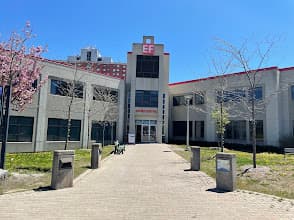
Conestoga College is a college and polytechnic in Kitchener, Ontario. That word matters for what you are about to write.
Conestoga awards Ontario college certificates, diplomas and advanced diplomas, Ontario College Graduate Certificates, and honours bachelor's degrees. Its degrees page lists 25 three-year and four-year bachelor's degrees across eight academic schools. It does not list a single master's degree or doctorate. So nobody at Conestoga is writing a PhD dissertation, and nobody is writing a master's thesis either.
What you may be writing is a bachelor's thesis, a capstone report, a consulting project, an applied research paper or a graduate-certificate project. Those have real requirements. They are just not the requirements a university thesis handbook would give you.
What Conestoga awards, and what each one ends with
| Credential | Typical culminating work |
|---|---|
| Ontario College Certificate, Diploma, Advanced Diploma | Placement, portfolio or applied project; no thesis |
| Ontario College Graduate Certificate | Capstone project or co-op work term |
| Honours Bachelor's Degree | Capstone or consulting project, and in some programs a two-level bachelor's thesis with a defence |
Conestoga's graduate certificates are not master's programs. They sit after a diploma or degree, they are usually one year, and they build toward employment rather than toward a research degree. If someone tells you to structure a graduate-certificate capstone like a master's thesis, they have not looked at your program.
Where a real thesis does exist
Two published examples show what a Conestoga bachelor's thesis actually looks like.
In the Bachelor of Business Administration (Honours), International Business Management, the course list sets out a clear sequence.
| Course | Code | Level |
|---|---|---|
| Research Methods | RSCH73105 | 4 |
| Introduction to Consulting | BUS73010 | 6 |
| Bachelor's Thesis I | BUS73020 | 6 |
| Bachelor's Thesis II | BUS73030 | 7 |
| Consulting Project | BUS74070 | 7 |
Bachelor's Thesis I asks you to work independently to develop a business thesis topic, synthesize theory with the research literature, and arrive at a novel research question and a proposed research design. Its stated outcomes are a thesis proposal and a completed Research Ethics Board application. Bachelor's Thesis II is where you carry out the study, analyze the data, develop results and findings, and discuss implications, producing a written thesis and a formal defence presentation.
In the Bachelor of Design (Honours) the shape is the same but longer: RSCH73000 Understanding Research at Level 5, then GRDN74110 Thesis I at Level 9 (3 credits, 42 hours) and GRDN74215 Thesis II at Level 10 (6 credits, 84 hours). Thesis I produces a topic, proposal and creative direction with formal written and visual material. Thesis II executes the project and ends in a substantive thesis with a formal defence.
Two things to take from this pattern. First, the proposal course is not a warm-up; it is where ethics clearance is meant to happen. Second, the second course carries roughly double the weight of the first, so plan your workload accordingly.
Conestoga does not publish a college-wide thesis specification. There is no central page giving a word count, margin size, binding requirement or chapter structure for a Conestoga bachelor's thesis. Your course outline and your faculty supervisor are the specification. Get the marking rubric in week one and write to it, rather than to a generic thesis template found online.
If you are working through the proposal-to-defence arc, our thesis writing support is built around that two-semester shape.
Research ethics is the deadline that catches people
If your project involves human participants, including surveys of your classmates or interviews with people at a placement employer, it goes to the Research Ethics Board. The REB applies the principles of the Tri-Council Policy Statement (TCPS 2), the national standard for research involving humans in Canada, built on respect for persons, concern for welfare, and justice.
What Conestoga publishes as required:
- The Application to Involve Human Participants in Research form, or the Common Ontario College REB Application form if the study spans several colleges
- The Checklist for Review of Information Letter and Consent Form, confirming your recruitment and consent documents are complete
- A TCPS 2 CORE-2022 certificate, proving you have completed the Tri-Council training
- A Locally Responsible Investigator Form if the principal investigator is not a Conestoga employee
Two procedural rules are easy to trip over. Your instructor must consult the REB Coordinator before students submit, so you cannot simply send in an application on your own initiative. And everything goes to the REB Coordinator directly: contacting individual REB members about your application is prohibited. For student course-based research, a Renewal or Completed Status Report is submitted at the end of the academic year.
The CORE-2022 training takes a few hours and the certificate is free. Do it in the first weeks of the proposal course, not the week the application is due.
Conestoga does not publish REB meeting dates or a review turnaround time on its public research ethics pages. Ask the REB Coordinator how long review takes before you build a data-collection schedule around it.
Formatting and citation
Conestoga maintains its own citation guide, APA @ Conestoga, based on APA 7th edition. It goes further than most college guides: paper format, title page, headings, order of sections, quoting and paraphrasing, visuals and appendices, plus a Comprehensive APA 7th Edition Student Paper Checklist.
Concrete requirements it publishes:
| Element | Requirement |
|---|---|
| Spacing | Double-spaced throughout |
| Sans serif fonts | 11 pt Calibri, 11 pt Arial, or 10 pt Lucida Sans Unicode |
| Serif fonts | 12 pt Times New Roman, 11 pt Georgia, or 10 pt Computer Modern |
| Title page order | Title, student name, affiliation, course name and code, instructor, due date |
| Title page layout | Double-spaced and centred, with three returns before the title |
| Page numbers | Top right corner of every page |
| Running head | Omitted on student papers |
Text inside tables, figures and images is exempt from the font rules.
Not every program uses APA. The college's own Gen AI guidance points students to citation instructions in both APA and IEEE, which tells you the engineering and computing degrees work in IEEE. Confirm from your course outline rather than defaulting.
For the shorter research papers and literature reviews that fill the years before a capstone, our research paper help works to the same APA and IEEE conventions.
Academic integrity, and the AI rule in particular
The governing document is the Academic Integrity Policy, AA-007, effective 5 September 2007 and last approved 1 August 2024. It defines an academic integrity violation broadly: conduct that fails to follow the rules governing conduct in an evaluation, results in an unfair academic advantage, or misrepresents a student's achievement of learning outcomes.
Penalties are graduated. A minor first violation may draw a Warning with no grade deduction, and you receive a maximum of one Warning. After that, violations are recorded as Offences, with penalties scaling by severity and repetition up to and including Discontinuance from the College. The penalty table itself is Appendix A of the policy.
On generative AI, Conestoga is unusually direct. Its Gen AI and Academic Integrity guidance states that using generative artificial intelligence without your instructors' permission violates the Academic Integrity Policy, and names the violation category: Using Unauthorized Aids and Assistance.
The practical rules it sets out:
- Check the assessment instructions first. If it is not in writing, email your instructor to confirm what is allowed and what is not.
- Where AI use is permitted, cite and acknowledge it, in APA or IEEE.
- Do not input private information, and do not paste copyrighted material into an AI tool without written permission.
The line the guidance draws is worth memorizing: it is fine to use a tool that helps you do the work, and not acceptable to use a tool that does the work for you. On a thesis with a defence, that line enforces itself anyway. You will be asked about your methods in front of a panel.
Applied research and industry partners
Conestoga runs a substantial applied research operation through its Office of Research Services, including centres such as the SMART Centre, and hires students into paid research positions advertised through MyCareer.
If your project runs with an industry or community partner, expect the partnership to bring its own paperwork: confidentiality terms, data-handling conditions and intellectual property arrangements. Conestoga does not publish a standard student research agreement template openly. Ask your project lead or the Office of Research Services what you are signing, and ask specifically whether anything in your report will be restricted from public presentation before you plan a defence around it.
Pre-submission checklist
- I have my course outline and marking rubric, and I am writing to those rather than to a generic thesis template.
- My program's actual requirement is confirmed: thesis, capstone, consulting project or portfolio.
- TCPS 2 CORE-2022 certificate completed and saved.
- REB application submitted through my instructor and the REB Coordinator, and approved before any data collection began.
- Consent and information letter checked against the REB's Checklist for Review of Information Letter and Consent Form.
- Citation style confirmed with my instructor: APA @ Conestoga, or IEEE if my program uses it.
- Title page carries title, name, affiliation, course name and code, instructor and due date, double-spaced and centred.
- Page numbers in the top right of every page, and no running head.
- Double spacing and a permitted font and size throughout.
- Run against the Comprehensive APA 7th Edition Student Paper Checklist.
- Any generative AI use permitted in writing by my instructor, and acknowledged and cited.
- No private or third-party copyrighted material pasted into any AI tool.
- Partner confidentiality and IP terms checked before anything goes into a public defence.
- Renewal or Completed Status Report planned for the end of the academic year if my research was course-based.
What this guide could not confirm
Conestoga publishes its integrity, AI and citation guidance more clearly than many institutions. Where it stops:
- No college-wide thesis or capstone specification: no published word count, margin size, chapter structure, binding requirement or submission portal.
- No published REB meeting schedule or review turnaround time.
- No published defence format: length, panel composition and assessment weighting are set at course level.
- No published open template for student research agreements with industry partners.
- No published institutional repository for completed bachelor's theses.
Each of those is a question for your faculty supervisor, your program coordinator or the Office of Research Services, and each is far cheaper to ask in your proposal semester than in your final month.
The short version
Find out what your program actually requires before you write anything. If it is a bachelor's thesis, the two-course structure means your proposal semester carries the ethics application, and missing that stalls the entire second semester. Use APA @ Conestoga unless your program says IEEE. Get AI permission in writing or do not use it. And treat your course outline, not any general thesis guide, as the document that decides your grade.