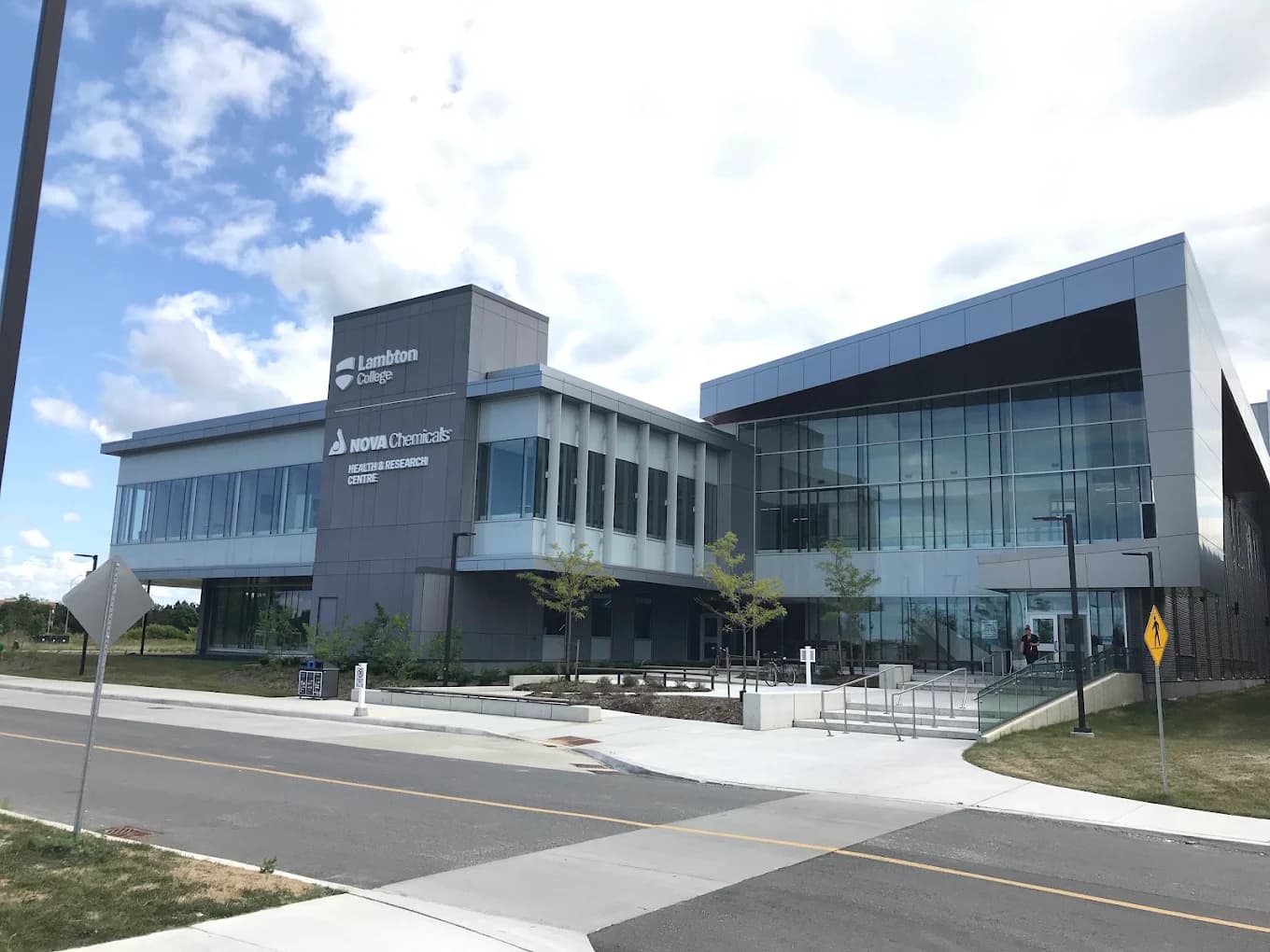
Lambton College in Sarnia, Ontario is a research-heavy college. Lambton reports being ranked the number five research college in Canada and number two in Ontario on the Research Infosource 2025 rankings, with 192 research students and 362 research projects.
That reputation can mislead a student. A large applied research operation does not mean Lambton awards research degrees. No Lambton program this guide could find requires a thesis or a dissertation. What students write is a capstone project, a report, an applied analysis or, if they are hired onto a research project, material that falls under the College's research policies rather than its assessment rules.
Those are two different tracks with two different rulebooks, and it is worth knowing which one you are on.
What Lambton awards
Lambton's program list offers certificates, diplomas, advanced diplomas and Ontario College graduate certificates, plus one degree-level credential in the full-time list: the Honours Bachelor of Science in Nursing.
The culminating written work in a taught program is a capstone. Lambton runs capstone courses across many programs under different codes, for example:
| Course | What it asks for |
|---|---|
| Capstone Information Security Project (ISN-2104) | Design and implement a comprehensive information security architecture, from planning and design through presentation of the final product |
| Capstone Project, Health Care Administration (HCA-5123) | Research, prepare and present an in-depth analysis of a current managerial problem facing health care administrators |
| Data Analytics Capstone (DTA-3084) | Research, plan and execute a project meeting a real-world financial, market or organizational need |
Two things follow from those descriptions. They are integrative rather than original, pulling together what a whole program taught. And most of them end in a presentation of a final product, not just a document. Plan for the presentation as a deliverable in its own right.
Lambton does not publish word counts, page lengths or report formatting specifications for its capstone courses on its open course pages. Those live in your course outline. Ask for it in week one.
If a long applied report is the thing you are stuck on, our research paper support works at that level.
Research ethics, and the calendar that governs it
This is the most concrete published process on Lambton's site, and the easiest to plan around if you know it exists.
The Research Ethics Board reviews research involving humans conducted at or under the auspices of the College, against the Tri-Council Policy Statement and Lambton's own Ethical Conduct and Policy for Research Involving Humans (2000-3-1).
The rules that matter for scheduling:
- All research involving human participants must complete ethics review before participant recruitment and data collection can begin.
- Applicants can expect acknowledgement within two to three business days.
- Incomplete applications will not be reviewed. Not delayed. Not reviewed.
- Above-minimal-risk applications go to regularly scheduled monthly meetings, with published complete-application deadlines. For 2026 these fall on the first Wednesday of most months: February 4, March 4, April 1, May 6, June 3, July 1, August 5, September 2, October 7, November 4 and December 2.
- Minimal-risk projects get a delegated review outside those monthly meetings.
Miss a deadline by a day with an above-minimal-risk project and you wait roughly a month. In a fourteen-week course, that is the difference between collecting data and rewriting your methodology.
Lambton also publishes what does not need review, which is genuinely useful:
- Quality assurance or program evaluation conducted solely to assess or improve operations
- Student assignments involving human participants where the goal is teaching clinical skills
- Research relying exclusively on publicly available information
- Research relying on secondary use of anonymous information
- Observation of people in public places, with no intervention staged by the researcher
If you are unsure, Lambton asks you to email [email protected] rather than assume. Take that offer. Getting a written "no review needed" is cheap; discovering afterwards that you needed review is not.
If you work on a funded research project
Lambton's Responsible Conduct of Research policy (2000-3-2) applies to "any employee or student of the College." If you are a paid student researcher, or your capstone is embedded in a funded project, this is your rulebook alongside the academic one.
One requirement is easy to miss: all employees and students involved in research are required to undertake professional development on the College research policies before beginning any research project. Ask your supervisor what that is and when you are doing it.
The policy's substantive duties are rigour in recording, evaluating and interpreting data; record keeping, specifically retaining original and accurate records of data, methodologies and findings, including graphs and images, so others can verify or replicate the work; accurate referencing and authorship; and prompt disclosure of any real, potential or perceived conflict of interest.
That record-keeping requirement is not a formality in applied research. Keep a dated, ordered lab or project record from day one rather than reconstructing one for a report.
Authorship and the partner approval rule
Lambton's authorship policy (2000-3-8) is where students on partnered projects find the surprise.
On a collaborative project with an external organization, Lambton researchers and students may present or publish aspects of a project only after receiving prior written approval from the partner. The partner must receive the presentation, publication, press release or other dissemination material so it can decide, suggest changes and grant approval. The policy also states that under Lambton's current intellectual property policy, IP rights are expected to be allocated to industrial partners for commercialization.
Read that before you plan a conference abstract, a LinkedIn post about your results or a portfolio piece for job interviews. Agree what you may show, and in what form, at the start of the project.
On who counts as an author, the policy sets a three-part test. Every co-author must have been directly involved in all three of:
- Planning and contributing to some component of the work (conception, design, conduct, analysis or interpretation), or interpreting at least a portion of the results
- Writing a draft of the article or revising it for intellectual content
- Final approval of the version to be published
The lead author is usually the person who performed the central work and prepared the first draft, usually serves as corresponding author, and is responsible both for ensuring every other author meets the criteria and for the integrity of the work itself. Honorary authorship is stated to be unacceptable, and partner staff who meet the authorship criteria must be listed with their corporate affiliation disclosed. People who contributed meaningfully without meeting the test must be acknowledged, and acknowledgements must include partner companies and funding agencies.
If you are a student on the project, the Responsible Conduct policy says you shall be given appropriate recognition for authorship or data collection in any publication. That is a right you can point to.
Academic integrity
Policy 2000-1-20, issued May 19, 2022, sets out academic dishonesty. Three of its listed offences matter most for capstone work.
Self-plagiarism is defined simply as "reusing wording or assignments previously submitted." Lambton's wording does not carve out an exception for work reused with permission, which makes it stricter on its face than many comparable policies. If your capstone builds on an earlier assignment, ask your instructor in writing before you reuse anything.
Unauthorized generative AI use appears inside the offence of "submitting as one's own, work completed by another person, or work completed through the unauthorized use of generative artificial intelligence applications." The word doing the work there is unauthorized, so permission is set by your instructor and your course.
Falsifying or inventing information is listed with two named examples: inventing data and statistics, and falsifying sources. Invented citations sit squarely inside this.
Sanctions are progressive and are assigned by different people depending on severity:
| Tier | Sanctions | Decided by |
|---|---|---|
| One | Warning and remediation; resubmission with reduced grade or zero, for assignments worth under 20% of the course grade | Faculty |
| Two | Resubmission with reduced grade or zero for assignments worth 20% or more; F, NP or TM grade in the course | Dean or delegate |
| Three | Suspension (minimum nine months, transcript notation, no fee refund); expulsion (transcript notation, no readmission for at least five years) | Senior Vice-President, Academic and Student Success |
Note the practical consequence of that 20 per cent line. A capstone is almost always worth more than 20 per cent of its course, so an integrity issue on a capstone goes to a Dean rather than being handled by your instructor. A grade imposed as a sanction also supersedes any other grade or status in the course, and you cannot continue in a course where the sanction applies to the final grade. Appeals go through the Student Appeal Policy.
Citation and formatting
The Library states plainly that APA style is used in most Lambton College courses, while advising you to check your assignment instructions or ask your instructor. It publishes a Lambton College APA Guide and lists formatting basics:
- Double-space the paper
- Use a readable font such as Arial 11, Calibri 11, Georgia 11 or Times New Roman 12
- Page numbers in the top-right corner
- Indent the first line of each paragraph
The Library is in C1-200, reachable at [email protected], offers one-on-one research appointments, and points students to The Learning Portal, the shared resource collection built by Ontario college libraries.
Pre-submission checklist
- Course outline obtained, with the actual capstone deliverables and weighting
- Presentation planned as a deliverable, not an afterthought
- Ethics review complete before any recruitment or data collection, or a written exemption confirmed with the REB
- Application submitted complete, by a published monthly deadline, if the project is above minimal risk
- Required research policy professional development completed, if I am on a funded project
- Original records of data, methods and findings retained and dated
- Partner's prior written approval obtained for anything I present, publish or post
- Authorship agreed against the three-part test, with partner contributors and funders acknowledged
- No reuse of my own earlier submitted wording without written instructor permission
- AI use limited to what my instructor authorized
- Every citation traced to a real source
- APA applied throughout: double spacing, approved font, top-right page numbers, indented paragraphs
What this guide could not confirm
Lambton publishes its research and integrity rules clearly and its assessment mechanics hardly at all. Open questions for your program coordinator:
- No published word count, page length or report format for any capstone course.
- No published capstone marking rubric or presentation format.
- No published student research agreement template for industry-partnered work, despite the partner approval rule; the terms sit in project-level agreements such as an IP Agreement or Master Collaboration Agreement.
- No published REB turnaround time beyond the two to three business day acknowledgement, so ask how long a full review typically takes.
- No published institution-wide AI guidance for students beyond the word "unauthorized" in the integrity policy; permission is set course by course.
- No published detail on whether the self-plagiarism rule admits an instructor-permission exception. Ask before reusing anything.
Where to get help
Your program coordinator and capstone instructor own the deliverables, format and weighting. The Research Ethics Board ([email protected]) handles applications, exemptions and deadlines. Research and Innovation handles partner agreements, IP and publication approval. The Library ([email protected]) handles APA and source finding, and runs one-on-one appointments.
If the writing itself is the obstacle rather than the rules, our essay writing support covers the report and analysis work most Lambton capstones ask for.