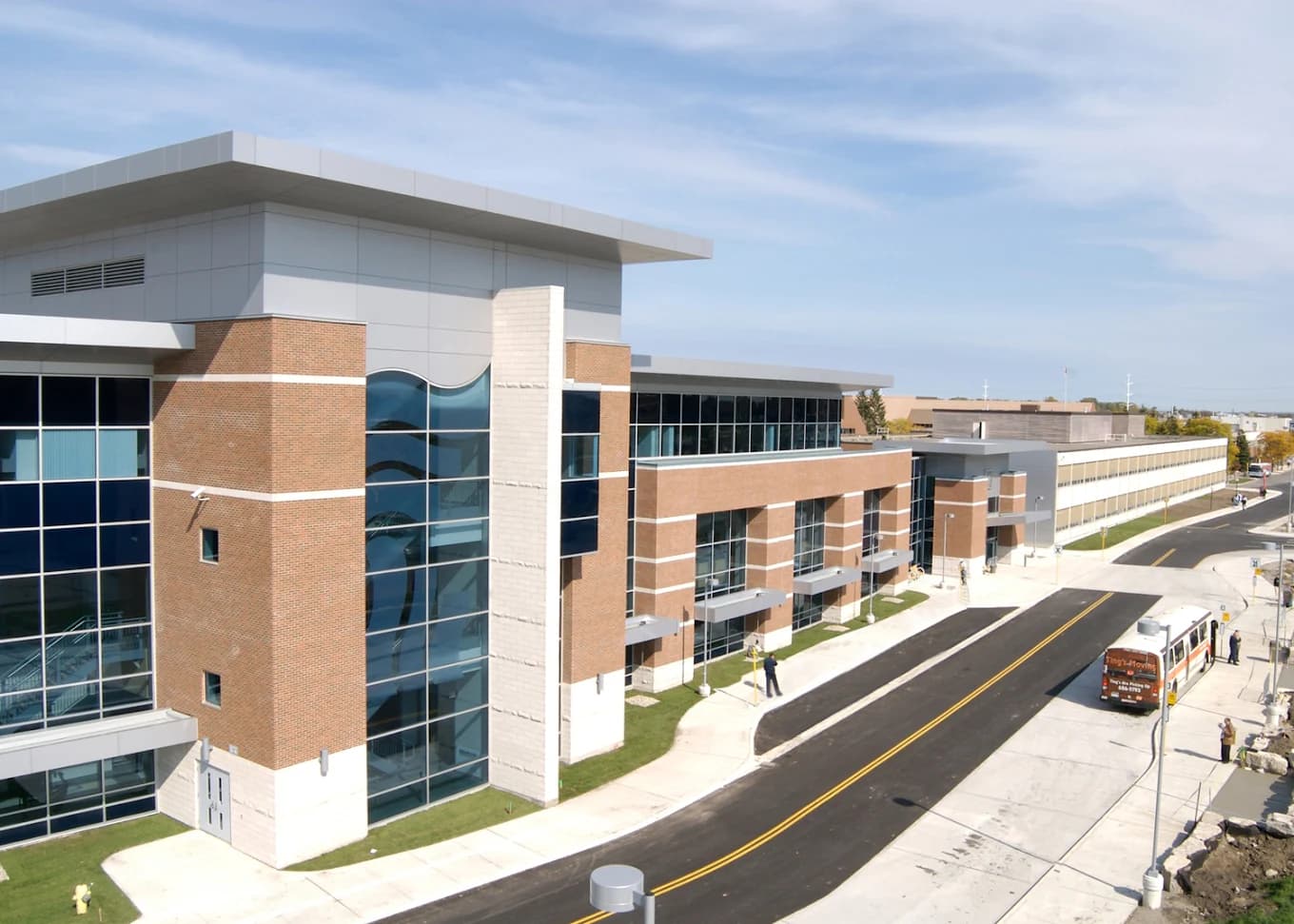
Fanshawe College is a college in London, Ontario. Before you look for thesis rules, look at what Fanshawe actually awards.
Policy A103: Fanshawe College Credentials, effective 23 November 2022 with a next review date of 23 November 2027, lists the whole set: Fanshawe College Certificate, Ontario College Certificate, Ontario College Diploma, Ontario College Advanced Diploma, Ontario College Graduate Certificate, Honours Degree, honorary credentials, Microcredential Badge, Microcredential Series Badge, Declaration of Academic Achievement (a minimum of 100 student course hours) and Letter of Recognition.
There is no master's degree and no doctorate on that list. Honours degrees are granted with the Minister's approval on the recommendation of the Post-Secondary Education Quality Assessment Board, which is the Ontario mechanism that lets a college award a degree at all.
So if you are at Fanshawe, you are not writing a doctoral dissertation. You are most likely writing a capstone research project, an applied research report or, in one program, a genuine undergraduate thesis.
What the final piece of writing actually is
Fanshawe's honours degrees generally end in a major supervised capstone. The Honours Bachelor of Early Childhood Leadership is a clear published example: a four-year, 120-week degree with a 14-week intensive internship between third and fourth year, followed by a Level 8 capstone course described as a supervised research project that integrates practical experience and knowledge. Students work with their internship site to identify an issue and complete a project on pedagogy or curriculum. One of the program's stated learning outcomes is applying research skills across formulating research questions and collecting, interpreting and disseminating data.
The Honours Bachelor of Behavioural Psychology is the exception that does use the word. That four-year, 135-week degree includes BSCI-7001 Applied Research Methods at Level 3, and its program page states the program culminates in students completing a thesis on a topic of their choice.
| Credential | What you write at the end |
|---|---|
| Ontario College Certificate, Diploma, Advanced Diploma | Applied projects, placement reports, portfolios; no thesis |
| Ontario College Graduate Certificate | Applied project or work term; no thesis |
| Honours Degree, most programs | Supervised capstone research project in the final year |
| Honours Bachelor of Behavioural Psychology | An undergraduate thesis on a topic of your choice |
Fanshawe does not publish a college-wide capstone or thesis specification. No central page gives a word count, margin, chapter structure or binding requirement. Your course outline, rubric and supervisor are the specification. Get all three in the first week of the capstone semester.
If your program does run a thesis, our thesis writing support works to the structure your supervisor sets rather than a generic template.
Research ethics: the part that runs on a calendar
Fanshawe's Research Ethics Board operates under College Policy A201, Scholarship, Research and Creative Activity, and applies the Tri-Council Policy Statement: Ethical Conduct for Research Involving Humans (TCPS 2), Revised 2018. The published principles it works from are respect for human dignity, free and informed consent, vulnerable persons, privacy and confidentiality, justice and inclusiveness, and balancing harms against benefits.
The routing matters more than most students realize:
| Situation | Who reviews it |
|---|---|
| Research with human participants that is part of a course | Your academic department. Go to your professor, not the REB. |
| Student research that is not part of a course | The REB directly |
| Research inside a faculty member's own program | The faculty member obtains REB approval |
| Minimal-risk research | May receive an expedited departmental review |
If review does go to the board, the submission package is a completed and signed application with its checklist, all final research instruments (surveys, interview questions, scripts) and all final documentation (consent forms, recruitment materials, correspondence). The word final is doing real work there. A draft survey is not a submission.
The scheduling detail worth writing in your planner: submissions are due Mondays for Thursday meetings, on a biweekly schedule published on the REB page. Miss a Monday and your realistic next review is about a fortnight out. Since you cannot collect data before approval, one missed deadline can cost you a month of a one-semester capstone.
Contact details for the REB Coordinator are published on that page. Use them early rather than in week eight.
AI: three levels, and you need to know which one you are under
Fanshawe published its Artificial Intelligence Academic Framework V1 in October 2024. It is more permissive in principle than many college policies and more demanding in practice.
The framework rests on three pillars: transparent and responsible use with adherence to privacy considerations, use of AI to create engaging and job-ready experiences, and a steering committee providing continuous exploration. It explicitly rejects a blanket ban, on the grounds that an overall ban fails to prepare students for a labour market where AI use is increasingly prevalent, and recommends a contextual approach instead.
The contextual approach becomes the three permission levels your professor declares for a course:
- Limited. Used where learning outcomes would be invalidated by AI use. You may use AI to study, but generative AI may not be used for the completion of, or to support the completion of, any assignment, test or exam without prior consent.
- Partial. Used where learning outcomes might be enhanced by AI. Your professor names the permitted uses (brainstorming, learning about a topic, revising, organizing thoughts, drafting outlines) and the prohibited ones. You are responsible for fact-checking and attribution.
- Full. Used where AI is beneficial or required for the learning outcomes. Use is actively encouraged.
Four framework recommendations that apply directly to you:
- Students should be required to cite use of AI in all submitted work. Attribution is not optional under Partial or Full.
- Microsoft Copilot is the recommended classroom version, specifically to avoid student or copyrighted material being fed into open models.
- In research, AI is allowed across all areas within the college's research guidelines, but human oversight is mandatory, the researcher is responsible for accuracy and appropriateness of AI-generated results, and clear documentation, permissions and disclosure are required.
- Fanshawe uses the Turnitin AI detector, with the expectation that faculty apply its findings with discretion and professional judgement. Use of unauthorized detection tools is not allowed, and no student work should be uploaded to an alternative detection tool.
That last point cuts both ways. Do not run your own writing, or anyone else's, through a third-party AI detector, and do not treat a detector score as a verdict.
If your course outline does not state a permission level, ask, and keep the written reply. Using generative AI without appropriate attribution and documentation as specified in the assessment may be treated as an academic offence.
Policy A136 and what an offence actually costs
The governing document is Policy A136: Academic Integrity, effective 18 December 2024 with a next review of 26 May 2026. It defines an academic offence as obtaining or attempting to obtain unfair advantage or credit for academic work by dishonest means, and adds a clause students often miss: the act can be intentional or unintentional. Not meaning to is not a defence.
Procedure A lists eleven categories of offence. The ones that catch honest students on a research project are:
- Not crediting the original source of ideas, images, information, quotations or other intellectual property
- Submitting electronic files or data created by another person without the instructor's permission
- Submitting academic work from another course without the instructor's permission, which is where reusing your own earlier literature review goes wrong
- Using material, resources or technologies that are not permitted in the preparation or completion of academic work, which is the hook unauthorized AI use hangs on
The consequence structure is unusually explicit. A first offence may draw a Formal Warning or a Penalty, and a maximum of one Formal Warning is permissible per student. A student may only accrue three Penalties, and the third is expulsion. The policy sets out the two possible paths plainly: Formal Warning followed by three Penalties, or three Penalties with no warning, with expulsion at the end of either. Both Formal Warnings and Penalties are documented with the Academic Integrity Office on the Academic Offences Form, and students found to have committed an offence are instructed to complete the Academic Integrity at Fanshawe College course.
Appeals open seven College business days after you are notified.
Faculty are recommended to enable Turnitin on FanshaweOnline submission folders for paragraph responses over 300 words, and the guidance is explicit that Turnitin may not be used as the sole indicator of an offence.
Citation and writing support
Fanshawe's Library Learning Commons sits at fanshawelibrary.com and publishes citation guides for APA and MLA, plus a writing guide and other citation style resources. It offers first-come drop-in academic help and bookable one-to-one writing and citation appointments, and can be reached at [email protected].
Fanshawe does not publish a single college-wide mandated citation style. APA is the most commonly supported, but engineering and technology programs frequently work in IEEE. Take the style from your course outline, not from habit, and apply one edition of one style consistently.
For the research papers and literature reviews that build toward a capstone, our research paper help works to whichever style your outline names.
Pre-submission checklist
- I have confirmed whether my program requires a capstone, a thesis or neither.
- Course outline, rubric and supervisor expectations in hand before I started drafting.
- Ethics routing confirmed: department review through my professor if course-based, REB directly if not.
- Ethics application submitted by a Monday deadline, and approved before any data was collected.
- Final (not draft) instruments, consent forms and recruitment materials included in the ethics package.
- My course's AI permission level identified as Limited, Partial or Full, in writing.
- All AI use cited and documented in the submitted work.
- Nothing private or copyrighted fed into an AI tool, and no work uploaded to a third-party AI detector.
- No material reused from another course without my instructor's permission.
- Every idea, image, quotation and data source credited.
- Citation style taken from the course outline and applied consistently.
- Partner or internship site confidentiality terms checked before anything is presented publicly.
What this guide could not confirm
- No published college-wide capstone or thesis specification: no word count, page format, margin, chapter structure or binding requirement.
- No published mandated citation style across the college.
- No published capstone or thesis defence format: whether there is a presentation, how long, and who assesses it are set at course level.
- No published open template for student research agreements with industry or community partners.
- No published institutional repository for completed capstone projects or theses.
- No published REB turnaround time beyond the Monday-to-Thursday submission cadence and the biweekly meeting schedule.
Ask your program coordinator, your capstone supervisor and the REB Coordinator. All three answer these faster than a search engine will.
The short version
Fanshawe's rules are clearer than most colleges' on the two things that actually get students into trouble, and vaguer than most on formatting.
Treat the ethics calendar as a hard constraint and work backwards from the Monday deadline. Get your course's AI permission level in writing and cite every use. Do not recycle work from another course. And take your formatting, length and structure from your course outline and supervisor, because Fanshawe does not publish those centrally and anyone who tells you otherwise is guessing.