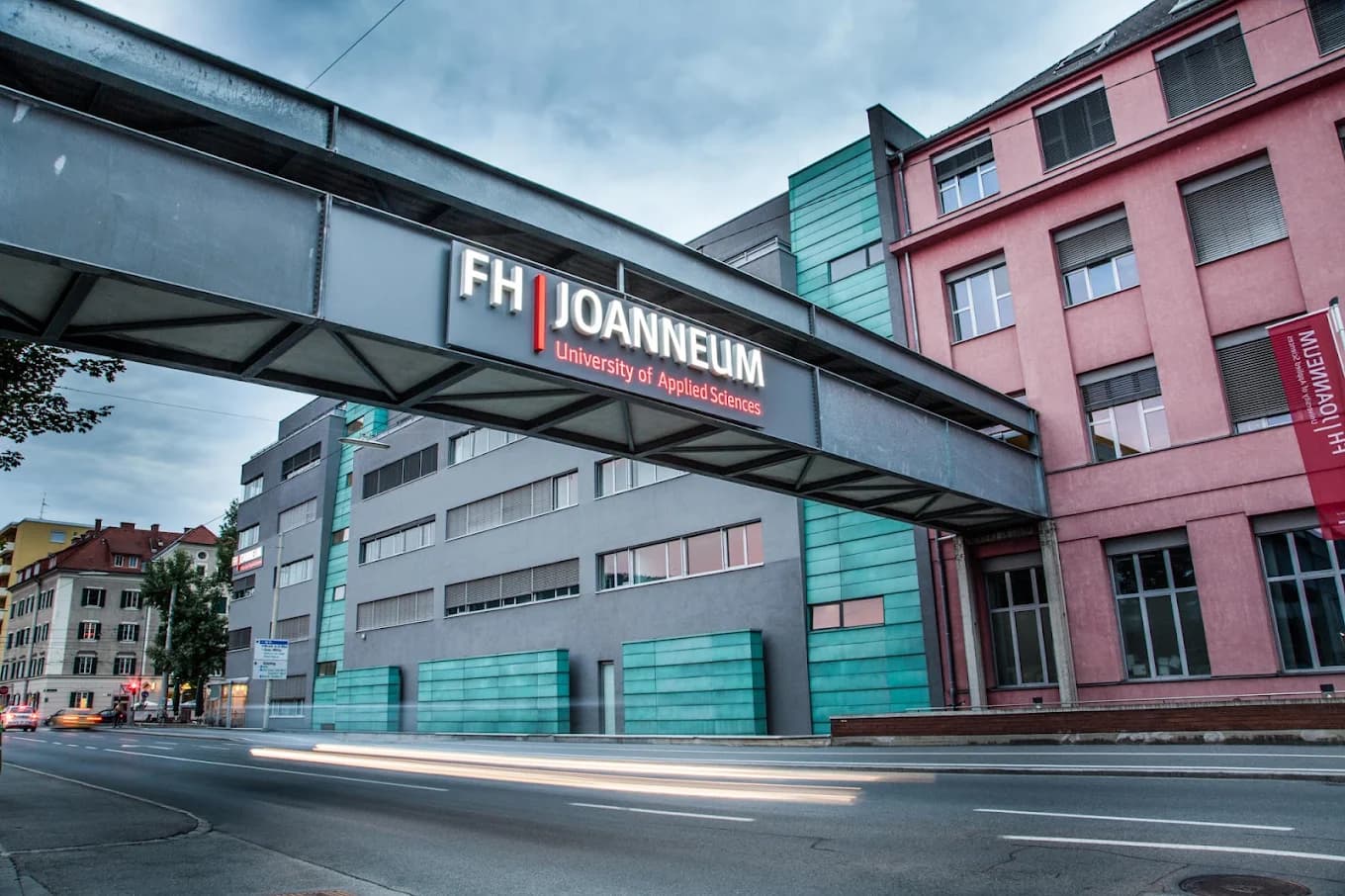
FH JOANNEUM is a Fachhochschule, so your thesis sits under the Fachhochschulgesetz (FHG) rather than the Universitätsgesetz 2002 that governs Austria's public universities. What makes FH JOANNEUM easier to plan for than most is that it publishes a single, genuinely detailed statute covering nearly everything: the Studien- und Prüfungsordnung, version 1.7 of 12 August 2025.
That document is in German. If you are studying in an English-taught programme, read it anyway, or work through the sections below, because it is where the deadlines live.
The rules that govern you, and the ones your programme adds
Three layers:
The FHG. § 19 requires a positively assessed master thesis to be published through the university library, and gives you the right to apply for exclusion of use for at most five years.
The Studien- und Prüfungsordnung. Sections § 25 to § 34 cover Bachelorarbeiten and the Bachelorprüfung. Sections § 35 to § 47 cover Masterarbeiten and the kommissionelle Abschlussprüfung. Note that Masterarbeit and Masterprüfung in this statute apply equally to a Diplomarbeit and Diplomprüfung where a programme uses those names.
Your programme's layout rules. The statute is explicit that formal presentation follows "the requirements of the respective degree programme (layout etc.)". FH JOANNEUM sets no university-wide font, margin or length rule. This is the gap you have to close locally, and the section below shows what one programme's version looks like.
What every FH JOANNEUM thesis must contain
The statute is specific about content that is easy to leave until too late:
- An abstract in English, in every thesis, bachelor and master alike. Where the language of instruction is not English, an additional abstract in the language of instruction.
- A table of contents and a bibliography.
- An unsigned Eidesstattliche Erklärung inside the digital final version, declaring that you wrote the thesis yourself and have not submitted it to another higher education institution for a degree.
- The signed declaration submitted separately, not inside the thesis. For data protection reasons it must not be published.
That split catches people out. The copy that goes into the repository carries an unsigned declaration; the signed one is uploaded on its own.
The library's publishing guide sets out the title page under ÖNORM A 2662: your name, the title and any subtitle, the type of thesis, the degree sought, the name of the university of applied sciences, the names of supervisors and assessors, place and year, and the name of the degree programme.
The same guide lists what must not go into a thesis that will be published: your CV, address, signature, matriculation number and telephone number, and anything that would breach someone else's privacy, which matters particularly if you quote interviews.
Formatting: the institution leaves it to your programme
There is no FH JOANNEUM-wide page count, word count, font or margin. What the statute does is list the formal criteria your thesis is marked against, which is arguably more useful:
- Coherent abstracts in the required languages
- Apt keywords
- A meaningful table of contents
- A stringent structure
- Correct citation, and correct marking of content produced with AI assistance systems
- Correct indexes, including one for AI assistance systems alongside literature, sources and figures
- Correct formal presentation according to your programme's requirements
- Scholarly expression, logically coherent argument, a clear through-line
- Correct grammar, orthography and punctuation
On citation style, the library guide says plainly that there are various sets of citation rules and that the principle is consistency: uniform, logical, traceable. Agree the specific style with your supervisor. FH JOANNEUM does not impose one.
For a sense of what a programme-level specification looks like, the Institut für Fahrzeugtechnik publishes its own. It requires A4 white paper of 80 to 120 g per square metre, single-sided printing in black, a text area set 36 mm from the top edge, 34 mm from the bottom, 31 mm from the left and 29 mm from the right, body text at 12 pt in a serif face such as Times or Cambria, footnotes at 10 pt, table footnotes at 9 pt, and line spacing of 18 pt. Bachelor and master theses must be handed in hard-bound.
Those figures bind Automotive Engineering students. They are not university policy. Ask your own programme for its equivalent document before you set up your template, because reformatting a finished thesis to different margins is miserable work at exactly the wrong moment.
Plagiarism software and the AI declaration
Before you submit, you are required to run the thesis through plagiarism software provided by FH JOANNEUM and send the result to your supervisor electronically. This is not something the university does quietly in the background; it is your step, and it applies to bachelor and master theses.
The standard declaration then requires you to state that you followed the university's Richtlinie zur Sicherung Guter Wissenschaftlicher Praxis, that you cited everything taken from printed, unprinted or internet sources, and that you have declared all assistance systems used in the methods description or in an index, with their use indicated at the corresponding passages. The form names the categories it means: chatbots such as ChatGPT, translation applications such as DeepL, paraphrasing applications, image generators and programming assistants.
You also acknowledge on that form that your work may be checked for plagiarism and for third-party authorship of human (ghostwriting) or technical origin.
Separately, the statute allows only those AI assistance systems expressly permitted by the lecturer in the syllabus to be used for assessed work, and provides that an assessment may be declared invalid where there is reasonable suspicion it was obtained through impermissible AI use. An invalidated assessment counts against your total number of attempts.
Read the two together. Declaring a tool does not make it permitted, and permission in one course does not carry to another.
Getting a topic and a supervisor
The topic proposal can come from you, from a lecturer, or from an interested party in industry or public administration. You then have to reach agreement with a member of teaching staff about the topic and the supervision, and the programme director approves both in writing and has it documented in the programme secretariat.
The supervisor is responsible for making sure the topic is realistically workable in the time available and suitable as evidence of your qualifications. Between you, your supervisor and any participating company, a procedure and schedule plan must be set. If you are working with a company partner, that plan is where you settle data access, confidentiality and timing, so do not treat it as a formality.
You must keep the supervisor regularly informed of progress, and the supervisor must tell you if it becomes foreseeable that your work will not be enough for a positive assessment. That is a warning system worth using deliberately: ask directly, in writing, at the halfway point.
Joint work on one topic is allowed as long as each student's contribution remains separately assessable, and the thesis must make clear which part you worked on independently.
English is permitted. Another language is possible with the programme director's consent, provided the supervisor commands it.
If you want structured help shaping the research question and the argument before you get to the writing, our thesis writing support is built around that stage.
Assessment and the four-week rule
The submission date for the final version is announced when the topic is issued. From then the timings are fixed:
| Step | Timing |
|---|---|
| Supervisor assesses the master thesis | Within four weeks of submission at the latest |
| Written confirmation of approbation submitted | At the latest when registering for the examination |
| Registration for the kommissionelle Abschlussprüfung | At least four weeks before the examination date |
| Positively assessed final version uploaded | Before the examination at the latest |
| Examiners announced to candidates | At least two weeks before the examination |
Theses are graded on the Austrian scale, Sehr gut (1) through Genügend (4), with Nicht genügend (5) for a fail, by the supervisor, who documents the assessment in a written report (Gutachten) and must make it known to you. A negatively assessed thesis gets a reasonable deadline to remedy the defects; in justified exceptional cases a new topic or a new supervisor can be chosen.
The marking criteria catalogue is communicated to students at the start of the final semester. Ask for it then rather than at the end.
The kommissionelle Abschlussprüfung
Admission requires all courses passed and the thesis approbated. For the Bachelorprüfung it also requires a positively assessed Berufspraktikum where the accreditation provides for one.
At least two examination dates are set per graduating cohort, fixed at the start of the final semester and communicated electronically without delay. The board has at least three people including the chair, and where the number of members is even the chair has a casting vote.
The examination is public by default. Where the thesis is blocked, the chair must hold it in camera, and the board has to be notified of confidentiality in writing and confirm it in writing.
For a master programme the examination has three parts:
- Presentation of the master thesis
- An examination discussion on the connections between the thesis topic and relevant subjects of the curriculum
- An examination discussion on other curriculum-relevant content
For a bachelor programme it is an examination discussion about the Bachelorarbeit or Bachelorarbeiten, which may include a presentation, plus their connections to relevant subjects of the curriculum.
These are parts of one examination, not separate examinations. A Nicht Genügend in any single part means the whole board examination is repeated.
| Result | Requirement |
|---|---|
| Mit ausgezeichnetem Erfolg bestanden | Outstanding performance, grade 1.5 or better |
| Mit gutem Erfolg bestanden | Clearly above average, grade above 1.5 up to and including 2.0 |
| Bestanden | Passed |
One asymmetry to know: the master thesis grade must flow into the final examination grade, because it is a thesis for the degree. The bachelor thesis grade does not feed into the Bachelorprüfung grade. Neither final examination grade counts toward your overall degree average.
A failed final examination can be repeated twice. A further attempt requires an application through the head of the Kollegium to the Kollegium within four weeks of the negative result being announced, and the Kollegium decides within eight weeks of receiving complete documents. Repeat dates are set between two weeks and half a year after the failure.
Publication, the repository and the Sperre
Submission runs through JOANNEUM|online, and publication has been compulsory since September 2021, as the library's page for students states.
| Work | Publication |
|---|---|
| Masterarbeit | Worldwide, in the institutional repository |
| Bachelorarbeit | At least campus-wide; full text retrievable by members of FH JOANNEUM |
| Abstracts of both | Worldwide |
| Signed declaration | Never published |
Theses appear in the ePUB repository and in the library catalogue. Even where the full text is not shown, the catalogue still carries metadata: author, title, extent, submission date, degree programme, supervisors, abstract, keywords, and the duration of any embargo.
The Sperrantrag gives you up to five years. The programme director must grant it where you make it credible that important legal or economic interests are endangered. A blocked thesis is handed in bound at the programme and kept securely and inaccessibly there for the embargo period; afterwards it can be consulted in printed form in the library. You keep the right to publish an anonymised abstract. The exact application procedure comes from your programme secretariat.
Two further points from the library guide that catch graduates out. Where a programme requires bound copies in addition to the upload, you provide them free of charge, and the number is capped at three. And under the Studienvertrag, FH JOANNEUM holds a non-exclusive licence to use works created during your studies, unlimited in time and place, including online. The guide also warns plainly about predatory publishers who approach graduates: consent to publish transfers rights and is normally not retractable, so ask the library before signing anything.
Pre-submission checklist
- Topic and supervision approved in writing by the programme director and documented in the secretariat.
- Procedure and schedule plan agreed with supervisor and any company partner.
- English abstract present, plus an abstract in the language of instruction if that is not English.
- Table of contents and bibliography present.
- Unsigned Eidesstattliche Erklärung inside the digital final version; signed one uploaded separately.
- Title page carries every element required by ÖNORM A 2662.
- No CV, address, signature, matriculation number or phone number anywhere in the thesis.
- Nothing in the text breaches a third party's privacy, interviews included.
- All AI assistance systems declared in the methods section or an index, and marked at the relevant passages.
- Only AI tools permitted in the syllabus were used.
- Plagiarism check run by me with FH JOANNEUM software, result sent to my supervisor.
- Layout matches my own programme's specification, not another institute's.
- Registration for the final examination lodged at least four weeks ahead, with written approbation.
- Sperrantrag lodged with the programme secretariat if the work is commercially sensitive.
- Bound copies prepared if my programme requires them, up to the maximum of three.
What this guide could not confirm
- No university-wide length, font, margin or spacing rule. These are set per programme. The Automotive Engineering figures quoted above are illustrative only.
- The plagiarism software is not named in the statute, and the "Maßnahmen der FH JOANNEUM zur Plagiatsprüfung" document is not published openly.
- The Richtlinie zur Sicherung Guter Wissenschaftlicher Praxis is referenced repeatedly but not published as an open page.
- No university-wide exposé requirement is set out, and no exposé template is published.
- No university-wide ECTS figure for the thesis; the statute simply says the time available corresponds to the ECTS workload in your curriculum.
- The detailed Sperrantrag procedure is handled by programme secretariats rather than published centrally.
Each of these is a single email to your programme secretariat, and each is far cheaper to ask in your first thesis semester than in your last week.
The short version
Everything binding is in one German-language statute, so read it or get someone to walk you through it. Put three dates in your calendar: the submission date announced with your topic, the four-week registration deadline for the final examination, and the start of your final semester, when the marking criteria catalogue is issued.
Then close the two gaps the statute deliberately leaves open. Get your programme's layout specification before you build the template, and agree a citation style with your supervisor rather than assuming one. And run the plagiarism check yourself, because nobody else will do it for you.