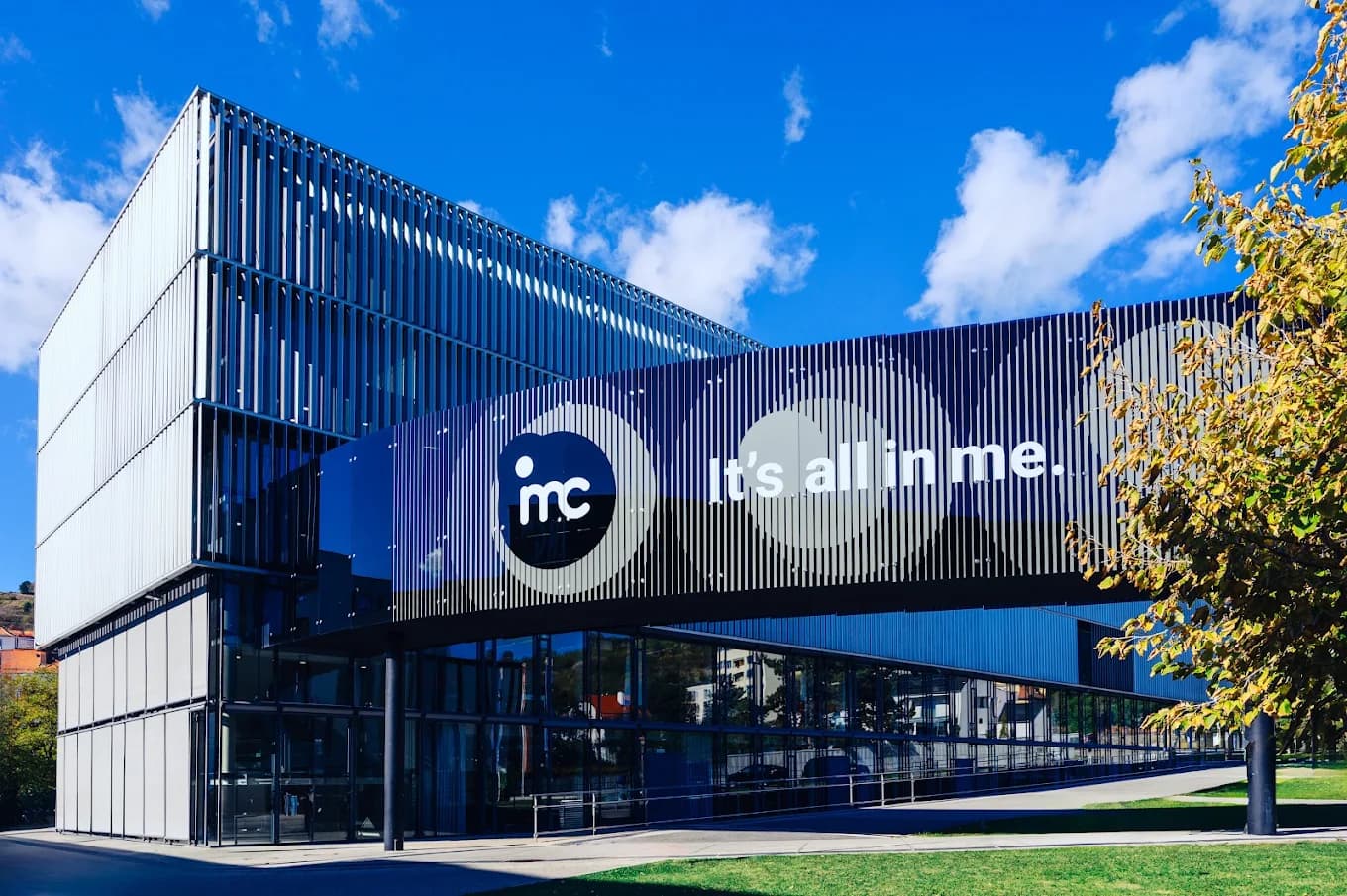
IMC Krems is a Fachhochschule, a university of applied sciences, and that single fact changes most of what you will read elsewhere about Austrian theses. Your studies sit under the Fachhochschulgesetz (FHG), not the Universitätsgesetz 2002 that governs Vienna, Graz and the other public universities. The FHG is more prescriptive about how a thesis is approved, assessed and examined, and IMC's own statutes fill in the rest.
This guide works through what IMC publishes, in the order it will matter to you, and is explicit about where the public record stops.
Which rules actually govern your thesis
There are three layers, in order of authority.
The federal law. FHG § 19 covers Bachelorarbeiten and Masterarbeiten. It permits several students to work on one topic as long as each student's contribution remains separately assessable. It makes approbation of the master thesis a precondition for admission to the final board examination, and requires that a non-approved thesis be returned for correction and resubmission within a set deadline. It also requires that a positively assessed master thesis be published by handing it over to the university library.
FHG § 16 sets the structure of the concluding examination for both bachelor and master programmes. Neither IMC nor any other Austrian FH can design that structure differently.
IMC's Study and Examination Regulation. Published in English and in German as document FHR-5-0035, version 11 revision 07, dated 19 November 2025. Section 3.8 covers Bachelor papers and examinations, section 3.9 covers Master theses and examinations, and section 3.7 covers invalidity and violations of good scientific practice.
Your programme's guideline documents. This is the layer that tells you what the thesis should look like, and it is the layer IMC does not publish.
The documents IMC does not publish
The statutes name several co-applicable documents by their internal reference numbers. These carry the practical detail:
| Document | Reference | What it governs |
|---|---|---|
| Manual for the Formal Composition of Scholarly Papers | FHM-5-0003 | Layout, structure, citation, the formal rules you use daily |
| Guidelines for Bachelor Papers and Bachelor Exams | FHM-5-0008 | Bachelor paper requirements and the Bachelor examination |
| Guidelines for Master Thesis and Master Exam | FHR-5-0009 | Master thesis requirements and the Master examination |
| Guidelines for Bachelor thesis submission and final BA exam dates | FHF-5-0135 | The actual submission and examination dates |
| Guidelines for Master thesis submission and final MA exam dates | FHF-5-0195 | The actual submission and examination dates |
| Regulation for the use of AI based systems | FHR-5-0044 | What you may and may not do with generative AI |
None of these appear on the public downloads page, which carries the statutes only. Ask your programme office for the current version of FHM-5-0003 and the guideline for your degree level in your first semester of thesis work. Every word limit, margin, font and citation rule for an IMC thesis lives in documents this guide cannot see, and formatting to a figure you found on a general Austrian thesis blog is a real way to lose marks.
The Bachelorarbeit and the Bachelor examination
In bachelor programmes you write one paper, produced independently within a course, following the Guidelines for the Formal Composition of Written and Scholarly Papers and the principles of good scientific practice. The topic and the exposé must be approved by the programme director before you submit, and if your paper needs surveys or studies, you may only carry those out after the exposé has been approved.
A positive assessment of the Bachelor paper, plus successful completion of all sixth-semester coursework, is what admits you to the Bachelor examination.
That examination is a comprehensive board examination taken before a subject-relevant board of at least three people, who must be present throughout. It covers the presentation and discussion of your Bachelor paper or papers, and their connections to appropriate subjects of the curriculum. In the Health Sciences programmes the board must include teaching and research staff covering both specialist and medical issues.
You must be told that you are admitted, and told who is on the board, at least one week in advance.
The Masterarbeit: exposé, the three-month rule and deadlines
Master programmes at IMC run four semesters and 120 ECTS, with the thesis in the fourth. The weighting varies by programme: the Marketing master, for example, allocates 22 ECTS to the master thesis and a further 4 ECTS to the Master Exam. Check your own curriculum rather than assuming.
The sequence in section 3.9 of the statutes is strict:
- The programme director approves your topic and proposal (exposé).
- Any surveys or studies may then, and only then, be carried out.
- The thesis may be submitted for assessment at the earliest three months after the exposé is approved.
That three-month floor is the single most schedule-relevant rule at IMC. If you are aiming at a particular examination date, work backwards from it and get the exposé approved at least three months plus your own writing time earlier.
Where your topic involves patient-related data, it must be approved by the ethical review committee, and the statutes place the submission to that committee on you, not on your supervisor. Any delay caused by the committee's proceedings has to be coordinated with your advisor and the programme director. Treat it as a separate, earlier deadline.
You can choose from several dates for the first submission and the first attempt at the Master examination. The period for final submission can be extended until the beginning of the third semester after you complete the coursework of the programme. Extensions are requested in writing to the programme director and decided jointly by the head of the academic board and the programme director under a dual control principle. Approval of the thesis and permission to sit the final examination are issued electronically.
How the Masterarbeit is assessed
Assessment takes the form of a moderated written report by your supervisor. The report and the grade are handed to you, so expect written reasons rather than a bare mark.
If the thesis is assessed negatively, you may revise it twice, with resubmission deadlines communicated in writing. If the second submission also fails, the programme director nominates a second assessor, and the third submission is assessed by a three-member committee consisting of the two assessors and the programme director.
Read that as a warning about the first submission. An escalating assessment structure exists to catch a thesis that was not ready, and the reliable way to avoid it is to have the argument and the method settled with your supervisor long before you are polishing prose. If you want structured help at that stage, our thesis writing support is built around it.
The final board examination
FHG § 16 requires the final master examination to be a kommissionelle Prüfung before a subject-relevant examination board, and IMC's statutes repeat the same three parts:
- a. presentation of the master thesis
- b. a defence of the thesis, and a discussion of the connections between your topic and relevant courses of the curriculum
- c. a conversation about other curriculum-relevant content
Part c is the one candidates underestimate. This is not a viva confined to your own work. You can be asked about content from across the curriculum, so revise the programme, not just the thesis.
The board must be present for the whole examination and decides the grade by collegial principle. Participation by an examiner or a student via video conference or other technical media is possible in justified cases. The schedule and the composition of the board are announced at least one week beforehand.
| Grade | Requirement |
|---|---|
| Passed with Distinction | Excellent performance; grade point average of 1.2 or better |
| Passed with Credit | Clearly above average; grade point average of 1.5 or better |
| Passed | All parts of the examination passed |
| Failed | At least one part of the examination failed |
A failed examination may be redone twice, and parts already passed can be excluded from the repeat. Dates sit in the Academic Calendar. A no-show without written substantial reasons costs you an attempt and counts as a regular attempt; you are treated as having sat the examination once you are present at the start of the preparation time.
Academic integrity, AI and proofreading
The integrity statutes define the offences plainly: plagiarism, including through incorrect application of citation rules; ghostwriting and ghost-sitting; forgery or undisclosed alteration of data, which expressly includes using AI to generate data; and unmarked resubmission, meaning self-plagiarism.
One useful exception is written into the self-plagiarism rule. Reusing parts of your own exposé in the thesis is explicitly permitted. You do not need to paraphrase your own approved proposal.
On AI, the statutes prohibit using artificial intelligence to generate answers in examinations and refer all further rules to the Regulation for the Use of AI-Based Systems (FHR-5-0044), which is not published openly. Ask for it. Do not assume a permissive default.
On proofreading, the integrity statutes distinguish authors, who are significantly involved in creating the work and hold copyright in it, from contributors, who supported it through financing, infrastructure, proofreading or help with data. Contributors are to be named. If someone proofreads your thesis, acknowledge them.
Enforcement has real teeth. Written papers may be put through internal or external peer review where there are reasonable grounds for suspicion. A paper declared invalid is rated failed. A thesis can be declared invalid after it has already been assessed, and an invalid master thesis can lead to exclusion from the programme or revocation of the degree. A ten-year limitation period applies to revoking bachelor and master degrees, and particularly serious cases involving intentional fraud do not become statute-barred at all. Reports go to [email protected].
Publication and the Sperrvermerk
FHG § 19 requires a positively assessed master thesis to be published by delivery to the university library, and entitles the author to apply for exclusion of use of the deposited copies for at most five years.
IMC's statutes implement this as a restriction note, or clause of confidentiality, at the same five-year maximum. Note the framing carefully: at IMC you apply on behalf of the contractor, which can also be IMC Krems itself, and must make it credible that publication would endanger the commissioning party's important legal or economic interests. Applications go in writing to the programme director, and the decision is issued in writing.
Two things a restriction note does not cover: publication of the abstract, and the defence of the paper within the examination. Where the work is genuinely sensitive, the chairperson of the examination board decides on excluding the public from the presentation, and that exclusion cannot be applied to faculty members and authorised IMC staff.
If you are writing with an industry partner, raise confidentiality at the exposé stage. A company expecting a blanket embargo covering the abstract too is expecting something IMC cannot give.
If something goes wrong with a grade
Under the FHG you cannot appeal against the assessment of an examination as such. What you can do, within two weeks, is complain to the programme director about a defect in how a negatively assessed examination was conducted. The programme director may annul the examination, and an annulled attempt does not count against your permitted number of attempts. Where the programme director conducted the examination, the complaint goes to the Kollegium instead.
Pre-submission checklist
- I have the current Manual for the Formal Composition of Scholarly Papers (FHM-5-0003) from my programme office and have formatted to it.
- I have the guideline for my degree level (FHM-5-0008 for bachelor, FHR-5-0009 for master) and the relevant submission and exam-date guideline.
- Topic and exposé approved in writing by the programme director.
- For a master thesis, at least three months have passed since exposé approval.
- No survey or study was carried out before exposé approval.
- Ethical review committee approval obtained where patient-related data is involved, submitted by me.
- Where several of us worked on one topic, my individual contribution is separately assessable.
- Every contributor, including anyone who proofread, is named.
- AI use checked against the Regulation for the Use of AI-Based Systems (FHR-5-0044).
- Nothing reused from a previous assessed work without reference, exposé material excepted.
- Restriction note applied for in writing if the work is commercially sensitive, with the company told that the abstract and the defence are not covered.
- Revision for the final examination covers the whole curriculum, not just the thesis.
- I know the board composition and my examination slot, notified at least one week ahead.
What this guide could not confirm
IMC publishes its statutes properly and its process rules are clear. The formatting layer is simply not public. Specifically, there is no published figure for:
- Word count or page count for a Bachelorarbeit or a Masterarbeit
- Font, font size, line spacing, margins or paper size
- Citation style
- Abstract length, required preliminary pages or declaration wording
- Exposé length or template
- Submission format: electronic file, bound copies, or how many
- The name of any plagiarism-detection software
- Specific submission and examination dates, which sit in FHF-5-0135, FHF-5-0195 and the Academic Calendar
- The ethical review committee's application process and turnaround time
Each of these is a single question to your programme office, cheap to ask in your first thesis semester and expensive to discover the week before submission.
The short version
Get the exposé approved early, because the three-month rule turns it into your real deadline. Get FHM-5-0003 from your programme office before you write a page, because the public record contains no formatting rules at all. Revise the whole curriculum for the final board examination, not just your thesis. And if there is a company partner, settle the Sperrvermerk question at the exposé stage, on the understanding that the abstract and the defence are never covered by it.