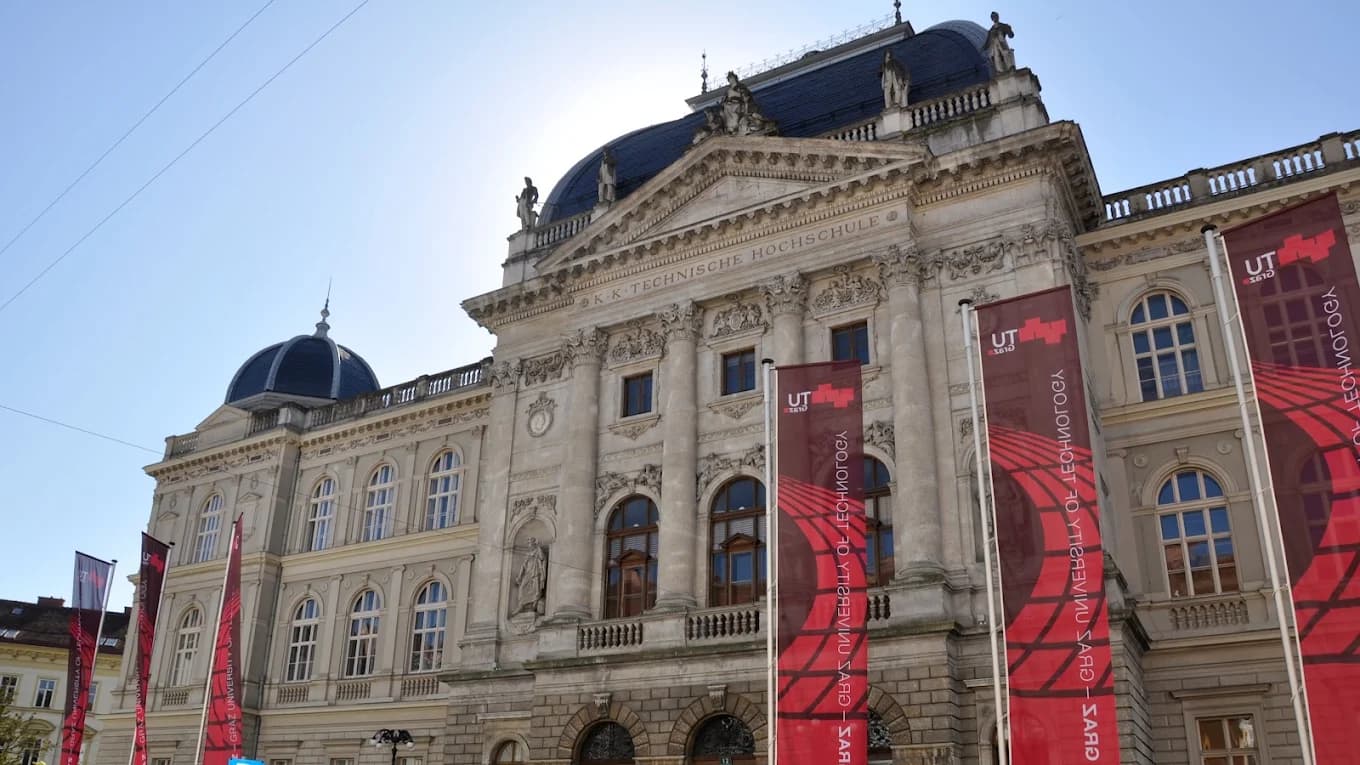
TU Graz splits its thesis rules across a small number of documents, and knowing which one answers your question saves a lot of searching.
- The Satzungsteil Studienrecht, the study-law part of the statutes, sets topic approval, assessment deadlines, examination senates and what happens to your thesis afterwards.
- The Satzungsteil Wissenschaftliche und Künstlerische Integrität covers integrity. It came into force in December 2025 and replaced both the old Satzungsteil Plagiat and the guideline on safeguarding good scientific practice, so anything you read about TU Graz plagiarism rules written before then may be out of date.
- Your Curriculum governs the specifics of your programme, and for doctoral candidates the statutes of your Doctoral School sit on top of that.
- Federal law, the Universitätsgesetz 2002 (UG 2002), sits above all of it, particularly § 86 on publication.
Getting a master's thesis approved
You may propose the topic yourself or pick from what supervisors are offering, and § 30 (1) puts a duty on supervisors to make sure topic and content actually match the workload the curriculum allows for. If you cannot find a supervisor, you have the right to have one assigned.
The administrative path is short and worth getting right:
- Apply for the thesis on your dean's office form, signed by your supervisor.
- Submit the form at the Dekanat. The Studiendekan approves it.
- If nothing is prohibited within one month, the topic and supervisor count as approved.
- Hold a Startgespräch (start meeting), then send your supervisor a plan of approach and a table of contents. Begin the work once your supervisor accepts the plan.
You may change supervisor at any point up to submission, and you have to report the change.
During the work, TU Graz's process description expects at least one interim report on your progress, and more if your supervisor wants them. Treat that as useful rather than bureaucratic. An interim report is the cheapest moment to discover that your supervisor pictured a different thesis than you did.
Do not include a curriculum vitae in your thesis. TU Graz warns about this explicitly on data protection grounds: your work is subject to the statutory publication duty, so a CV inside it becomes visible to the public. Submitting anyway counts as acknowledging that you were told.
Writing, templates and language
TU Graz does not prescribe a page layout centrally. What it does issue is a template for the cover page (Deckblatt) and the eidesstattliche Erklärung (affidavit), and you are expected to use it. Institutes and dean's offices publish their own writing guides on top of that, and those are the ones that will tell you about fonts, margins and citation style.
The required structure of the affidavit is fixed by the integrity statute. It must state clearly that:
- the work was written independently and no sources or aids other than those named were used;
- content taken from third-party or your own works, word for word or in substance, is marked as such and its origin shown by a source reference;
- all requirements of good scientific and artistic practice under the TU Graz statutes were observed.
On language, ordinary students are entitled to write academic works, which the statutes define as master's theses and dissertations, in a foreign language if all supervisors agree. For a dissertation, the doctoral curriculum recommends writing in whatever language is usual in the field.
Integrity, AI and the similarity check
The integrity statute is worth reading in full if you work in engineering or computing, because its definition of plagiarism is written for that world. Alongside text, theories, hypotheses, findings and data, it names the unacknowledged taking of designs, constructions, circuits, diagrams, mathematical derivations and proofs, models, structures, manufacturing and analysis procedures, algorithms, architectures and source code, including where these were derived by reverse engineering or porting an available technical solution.
Two other provisions matter to how you work:
- Misuse of artificial intelligence applications is listed as the use of an unauthorised aid.
- Ghostwriting is prohibited whether paid or unpaid, and so is offering such services. Commissioning another person to write a paper or sit an examination falls in the same category.
The check itself is not discretionary. TU Graz runs automated similarity checks, and every academic final thesis must be put through a final plagiarism check by the supervising person using that automated check, after you have uploaded the final machine-readable version. The statute says expressly that this happens even where an exclusion of use under § 86 (4) UG 2002 exists or is intended. An embargo protects your thesis from publication, not from checking.
Where misconduct is established after grading, the grade is declared void and counted against your permitted attempts. In serious cases your supervisor may refuse to supervise you again, and exclusion from studies for up to two semesters can be imposed by formal decision, starting in the semester after the finding. Where a degree turns out to have been obtained by serious misconduct, it is revoked under § 89 UG 2002.
None of this rules out legitimate help. It rules out someone else doing the work. If you want support that stays firmly on the right side of that line, structural and argumentative coaching rather than text production, that is what our thesis writing support is for.
Submitting a master's thesis
| Step | Where |
|---|---|
| Record the thesis | TUGRAZonline |
| Automated plagiarism check | Runs on the uploaded file |
| Assessment and electronic release | Your assessor |
| Bound copy | Your Dekanat, to its own published instructions |
| Formal submission for assessment | The Studienrechtliches Organ, via the Dekanat |
The statutory deadline then applies: the master's thesis must be assessed within two months of submission. If it is not, you can apply to have it assigned to another qualified university teacher.
Dean's offices differ on how many bound copies they want and what has to accompany them. Check your own Dekanat's page before you pay for binding; the statutes leave this to them.
The doctorate
Doctoral study at TU Graz runs through a Doctoral School, and several requirements have no equivalent at master's level.
Before you start. A supervision commitment (Betreuungszusage) from at least one supervisor must exist at the time of admission. You also conclude an Ausbildungsvereinbarung (training agreement) containing a short description of the dissertation project, signed by you, your supervisors and the Studienrechtliches Organ.
While you work. You submit a written annual report to your supervisor on the progress of the work, and your supervisor responds in writing. Both are made available to the first and second groups of the Doctoral School. If five years pass after admission without the dissertation being submitted, the report has to explain why.
Reviewer pre-selection. This is the provision most people discover too late. The doctoral curriculum says the pre-selection of reviewers should happen at the latest two months before you submit, and that from that point all reviewers are to be made familiar with the preliminary version of the dissertation. Plan backwards from that, not from your submission date.
Publish as you go, or get an extra reviewer. Publishing completed parts in international outlets, even before the dissertation is reviewed, is recommended. Where such publications cannot be demonstrated at the time the reviewers are appointed, at least three reviews must be obtained, of which at least one must come from outside TU Graz. A cumulative Manteldissertation built around several publications is allowed, but you cannot skip the final written overall work, and it must include a publication list.
Assessment. Two university teachers assess within a maximum of four months; the second may come from a closely related field, at least one reviewer should be from outside TU Graz, and not all reviewers may work at the same institute. One negative review brings in a further reviewer from a closely related field who has two months. More than one negative review means the assessment is negative overall. Where reviewers cannot reach a majority on a grade, the proposed grades are averaged and rounded, with anything above 0.5 rounded up.
Professors and permanently employed habilitated staff in the field are told when the reviews arrive and may submit comments within two weeks, under a duty of confidentiality. You see the reviews after the grade is announced, under § 84 UG 2002.
The Rigorosum
The Rigorosum is the final examination of the doctoral programme. The date is set once your coursework is complete, your annual reports are in and the positive reviews are there.
- It takes place publicly before an examination senate of at least three people.
- Examiners are proposed by the Doctoral School coordinators, taking account of your right to propose. They need not be your reviewers, and they may not work at the same institute.
- It has two parts: a talk of appropriate length on your research, and an oral examination in the field of the dissertation.
- Deliberation and voting happen in closed session, by majority; the chair votes last and their vote decides a tie.
The curriculum's footnote suggests, as guidance rather than a rule, a talk of 30 to 45 minutes and about 20 minutes of examination per examiner, with the examination part having the character of a defence of the dissertation. Each Doctoral School may set its own uniform guidelines for how the Rigorosum runs, so check yours.
One protection is worth knowing: under § 26 (3) of the statutes, where a presentation or questioning concerns the content of a thesis subject to a use restriction under § 86 (4) UG 2002, that part of the examination is not public, on your application.
The overall grade
The overall result combines three grades: the dissertation, the Rigorosum and the curricular part. It reads "bestanden" where all three are positive, and "mit Auszeichnung bestanden" where at least half are "sehr gut" and none is worse than "gut". In practice that means three "sehr gut", or two "sehr gut" and one "gut".
Publication and the embargo
§ 29 (5) of the statutes requires positively assessed academic and artistic works to be published by handing them to the TU Graz library in electronic form as a PDF, with electronic publication in a publicly accessible repository. The Library and Archive runs the repository side of this.
The restriction rules in § 29 (6) are precise:
| Stage | Duration |
|---|---|
| Initial exclusion of use | 2 years |
| Extension, once, on application | Maximum 3 further years |
| Statutory maximum | 5 years (§ 86 (4) UG 2002) |
The extension has to be applied for in good time before the first two-year period expires, and the grounds under § 86 (4) must still hold. For a dissertation, the doctoral curriculum adds that the work is normally made publicly accessible after the Rigorosum, that a time-limited restriction can only be applied for at submission and only in justified exceptional cases, and that the restriction must be notified to your Doctoral School.
If you are working with an industrial partner, or you intend to place a monograph or a patent application ahead of publication, that conversation belongs at the start of the project.
Pre-submission checklist
- Application form signed by your supervisor submitted at the Dekanat, and the one-month approval window elapsed.
- Plan of approach and table of contents accepted by your supervisor before starting.
- At least one interim report delivered.
- Official cover page and affidavit template used, with the affidavit worded as the integrity statute requires.
- No curriculum vitae anywhere in the document.
- Foreign-language drafting cleared with all supervisors, if applicable.
- Any AI use kept within what your course and the integrity statute allow, and declared where required.
- Source code, algorithms, circuits, derivations and diagrams taken from others properly attributed.
- Final machine-readable version uploaded, and the supervisor's final similarity check completed.
- Bound copy prepared to your Dekanat's published instructions.
- Doctoral candidates: reviewers pre-selected at least two months before submission and given the preliminary version.
- Doctoral candidates: embargo applied for at submission if needed, and the Doctoral School informed.
- Two-year expiry of any restriction diarised so the extension is not missed.
What TU Graz does not publish centrally
No margins, font or line spacing. The statutes are silent. Templates and institute guides fill the gap.
No word or page limit for a master's thesis. Scope is governed by the ECTS workload and by your supervisor's judgement under § 30 (1).
No named similarity-checking software. The integrity statute mandates the check, not a product. Ask your supervisor which tool is used if you need to know.
No fixed number of bound copies. Your dean's office decides.
No single Rigorosum format. The two-part structure is fixed; the timings in the curriculum are an explicit suggestion, and Doctoral Schools may set their own.
The short version
TU Graz is precise where it matters and hands the rest to your Dekanat and Doctoral School. The three deadlines to write down are the one-month approval window at the start, the two months your assessor has at the end, and, for doctoral candidates, the two months before submission by which reviewers should be pre-selected.
The three things to build in from the beginning are the affidavit in the university's own wording, a clean attribution trail for code, designs and derivations as well as text, and an early decision about whether any part of the work needs an embargo. Everything else is your institute's style guide, and that is a much easier conversation. If you want to know what outside support for the writing itself costs, our pricing page sets it out.