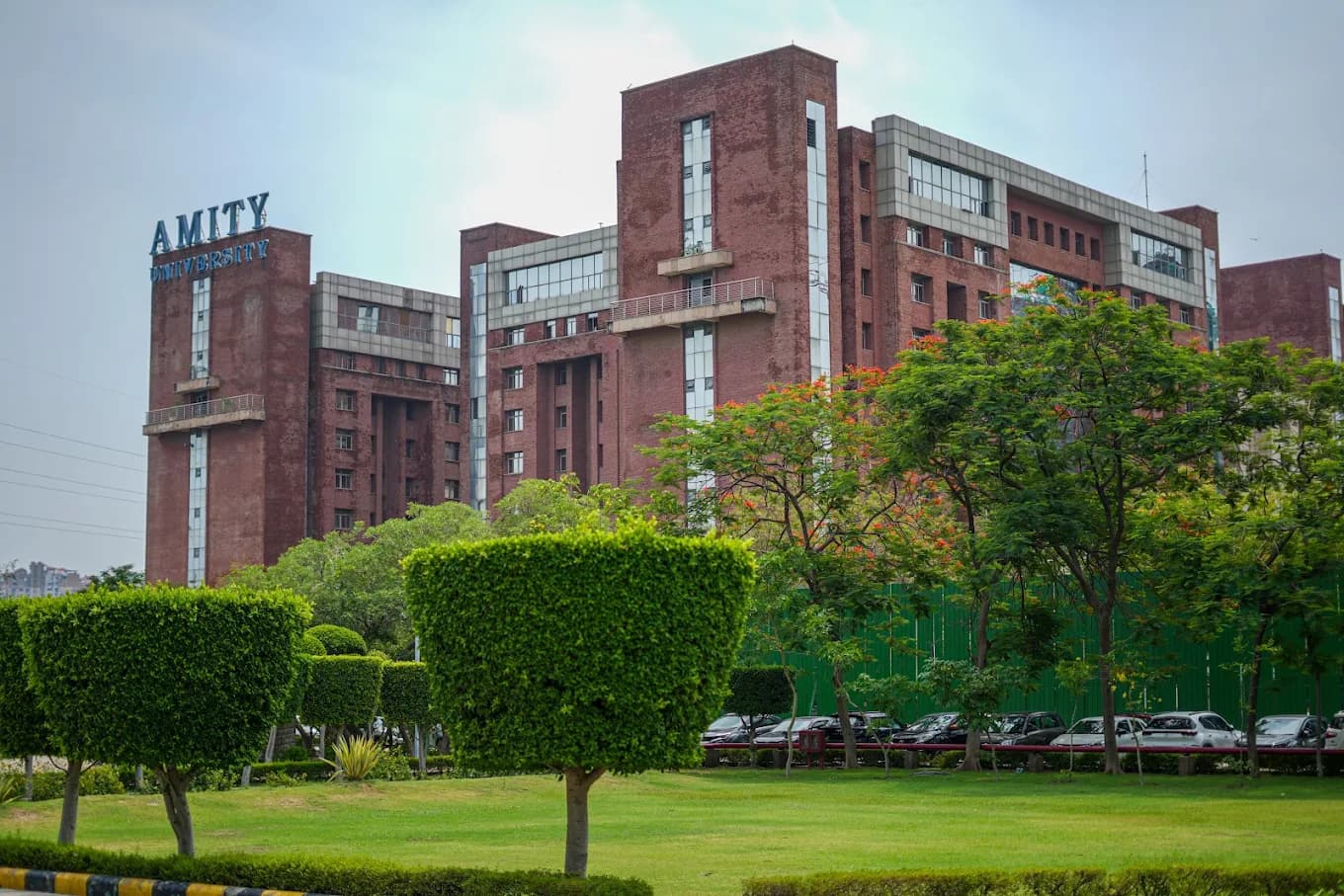
Amity's PhD sits inside the UGC 2022 national framework, set out in full in our Manipal guide. Amity adds several requirements of its own, and two of them are unusual enough to plan around from the start.
The publication requirement, stated precisely
This rule circulates in garbled forms, so here is what the regulations actually say:
A Ph.D. scholar may replace the requirement of two research papers with one research paper and one patent (published) for thesis submission. The published papers shall preferably be indexed in SCOPUS or Web of Science. The Ph.D. scholar must be the first author in the publications required for thesis submission.
Unpacking that:
- The baseline is two research papers
- A published patent may substitute for one of them, leaving one paper plus one patent
- The patent route is an alternative, not an extra requirement on top
- Indexing in SCOPUS or Web of Science is preferred, not absolutely mandatory, though you should treat it as the expectation
- First authorship is required on whatever you use to satisfy this
Evidence is submitted as a presentation certificate and/or reprints.
A warning about the patent route
The word doing the work is published. A patent application that has been filed is not a published patent, and the gap between the two is measured in months to years depending on jurisdiction and whether early publication is requested.
If you are considering this route, find out the realistic publication timeline in your jurisdiction before you rely on it. For many scholars, two journal papers will actually arrive sooner than one paper plus a granted, published patent.
Coursework and attendance
| Element | Requirement |
|---|---|
| Duration | Ordinarily a minimum of six months; at least one semester, not exceeding one academic year |
| Full-time classes | All working days, 9:15 am to 6:10 pm |
| Part-time classes | Saturday and Sunday, 9:15 am to 6:10 pm |
| Attendance per course | Minimum 75% |
| Full-time promotion | Minimum 90% attendance of total working days each semester |
Two attendance figures, and they do different jobs. 75% per course makes you eligible for that course's end-semester examination. 90% of total working days governs promotion for full-time scholars. The second is stricter and less widely known.
For part-time scholars, note that coursework runs on weekends, full days. That is a real commitment to plan employment around.
The comprehensive examination
After coursework:
A combination of both written and oral examinations, conducted by the concerned institution, requiring at least Grade B+ (7 points on a scale of 10).
Both components, one grade threshold. B+ is above a bare pass, and this sits between you and progressing.
Duration
| Route | Minimum | Maximum |
|---|---|---|
| Full-time, entering with a master's | 3 years | 6 years |
| Full-time, direct entry from a bachelor's | 4 years | 6 years |
| Part-time | 3.5 years | 6 years |
The minimum residency period for full-time candidates in the department is ordinarily three years.
The examiner panel: eight to two
This is Amity's other distinctive procedure.
Names and contact details of at least eight examiners from India or foreign countries, not below the rank of Associate Professor, in the research area of the candidate, in a sealed envelope. The examiners suggested by the supervisor may not be more than two from any one state of the country.
From this panel, the President (Vice Chancellor) shall appoint two examiners.
Three things follow.
Eight is a lot of names. Assembling eight genuine subject experts at Associate Professor level or above takes research. Start the list early and keep it updated as you read; the papers you cite most are a natural source.
The geographic spread rule is real. No more than two from any one Indian state among those your supervisor suggests. A panel drawn entirely from your own region will be rejected.
You do not choose your examiners. You propose; the Vice Chancellor selects. So there is no point optimising the list toward one favoured name. Every name on it should be someone you would be content to be examined by.
Pre-thesis presentation
The pre-thesis submission presentation may be conducted by the Head of Institution in consultation with the supervisor not before 3 months of the expected final submission.
Note the direction of that constraint. It is a floor, not a ceiling: the presentation cannot happen more than three months before you expect to submit. This makes it a late checkpoint confirming you are nearly done, rather than a mid-course review.
Plagiarism check
The submission carries a Turnitin report on plagiarism check of the Ph.D. thesis with the percentage of similarity index attached, signed by the research scholar, the supervisor and the Head of Institution or Head of Department.
The regulations note the check runs excluding research publications from the Ph.D. thesis work, which matters where your own published papers form part of the thesis: your own prior publications should not be counted against you as similarity.
Amity does not publish a specific threshold percentage on these pages. Ask your supervisor what figure your institution applies.
Evaluation and the open viva
Once all examiners have reported:
The guide will ensure that all corrections and modifications suggested by the examiners have been incorporated in the four hard bound final copies of the thesis, to be submitted before the viva-voce examination is held.
A copy incorporating the modifications also goes to the Office of the Dean Research before the viva.
If the thesis is recommended, an open viva-voce is held before a board comprising:
- One External Examiner, who will be one of the thesis examiners, with the name approved by the President (Vice Chancellor)
- The Director, Head of Institution or Coordinator of the concerned School, Centre or Institute
- Further members per the regulations
The date, time and venue are notified by the Office of the Dean Research.
Sequence at a glance
| Stage | Detail |
|---|---|
| Coursework | 6 months to 1 academic year; 75% attendance per course |
| Comprehensive examination | Written and oral; Grade B+ minimum |
| Publications | 2 papers, or 1 paper + 1 published patent, first author |
| Examiner panel | 8 names in a sealed envelope; VC appoints 2 |
| Pre-thesis presentation | Not before 3 months of expected submission |
| Thesis evaluation | By the two appointed examiners |
| Corrections | Incorporated into 4 hard bound copies |
| Open viva voce | Before a board including one external examiner |
Pre-submission checklist
- Two first-author papers, or one paper plus a published patent
- Publications preferably indexed in SCOPUS or Web of Science
- Reprints or presentation certificates ready as evidence
- Coursework complete with 75% attendance in each course
- 90% attendance of working days maintained, if full-time
- Comprehensive examination passed at Grade B+ or above
- Eight examiner names assembled, no more than two per state
- Pre-thesis presentation scheduled within three months of submission
- Turnitin report attached, signed by me, my supervisor and the HoI or HoD
- Four hard bound copies prepared after incorporating examiner corrections
- Inside the six year maximum
Where to get help
The Office of the Dean Research owns examination arrangements, the viva and submissions. Your supervisor owns the examiner panel and the academic content. Amity operates across multiple campuses with their own regulation documents, so confirm you are reading the one for your campus.
If the writing is the bottleneck, our thesis writing support works chapter by chapter, our PhD thesis help covers doctoral work, and our research paper support is relevant if the publication requirement is what stands between you and submission.