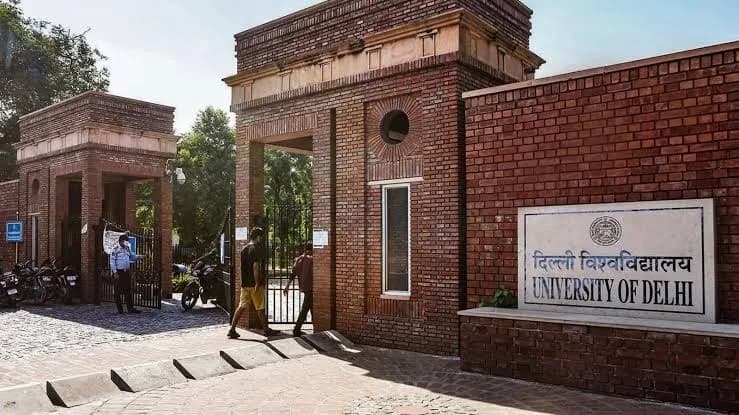
The University of Delhi is a central university, and its doctorate is governed by Ordinance VI-B, sitting inside the UGC 2022 framework described in our Manipal guide.
Ordinances are amended periodically, so check the research ordinances page for the version current to your registration rather than relying on a copy hosted by a department.
Duration
Per UGC Regulations 2022, the programme is a minimum of three years including coursework and a maximum of six years from the date of registration.
Note including coursework, as at Sharda. The coursework semester sits inside the minimum rather than before it.
Three external examiners, and who cannot be one
Delhi's examination arrangement is stricter about independence than most:
The thesis shall be evaluated by three external examiners who are experts in the field and not employed by the University. Such examiners should be academics with a good record of scholarly publications in the field. Those who have retired from the University of Delhi will not be appointed as external examiners.
Three things to draw out.
Three, not two. Most Indian universities appoint two. Delhi's threshold for agreement is therefore higher, and a divided panel is a genuine possibility.
None may be employed by DU. So there is no internal examiner in the sense used at many universities.
DU retirees are excluded. This is unusual and deliberate. A recently retired Delhi professor might know your supervisor well and have supervised in the same department for decades; the rule removes that entire category rather than relying on case-by-case judgement about conflicts.
All three are approved by the Vice-Chancellor.
The viva
The viva voce examination, on the evaluation report, shall be conducted by the Head of the Department and at least one of the three external examiners, as approved by the Vice-Chancellor.
So the Head of Department chairs, and at least one external examiner attends.
A deadline that works in your favour
The evaluation process of the Ph.D. thesis, including the declaration of the viva voce result, must be completed within a period of six months from the date of submission of the thesis.
Most regulations set deadlines for candidates. This one binds the University. Six months from submission to declared result is a firm outer limit, and it is worth knowing if your process appears to be drifting: there is a rule you can point to.
The Library holds the plagiarism gate
Delhi routes originality checking somewhere unusual:
The University shall evolve a mechanism using well-developed software to detect plagiarism and other forms of academic unethical practices. Each thesis will go through a Plagiarism Check that will be verified by the University Library before submission. The certificate of verification given by the Library has to be submitted along with the thesis at the time of thesis submission in the Examination Branch.
Two practical consequences.
The Library is a step in your timeline, not an afterthought. The thesis has to go through the check and the certificate has to be issued before you can submit. Find out the Library's turnaround time and build it in.
The certificate is a required document. A thesis arriving at the Examination Branch without it is incomplete. This is the sort of thing that costs a submission window.
DU does not publish a threshold percentage in the ordinance text. The UGC's academic integrity framework governs the categories of plagiarism and their consequences; ask your department what figure it applies in practice.
Coursework
Research scholars shall attend lectures and participate in seminars arranged in the Department. The minimum percentage of lectures to be attended will be two-thirds of the lectures delivered in all courses, individually.
Two-thirds is roughly 67%, slightly below the 75% several private universities require. But note individually: the threshold applies per course, not across the coursework as a whole.
Seminar participation is named alongside lectures as a requirement.
Progress review
The research scholar shall appear before the Research Advisory Committee once in six months to make a presentation of the progress of the work for evaluation and further guidance. The six-monthly progress reports with the comments of the RAC shall be submitted to the DRC, with a copy to the research scholar.
The reporting line matters: reports go from the RAC to the Departmental Research Committee (DRC), with the comments attached, and you receive a copy. Read those comments carefully; they are the formal record of how your progress is viewed.
Where progress is unsatisfactory, the ordinance provides for consequences, so a pattern of weak reviews is not merely advisory.
Choosing a supervisor
Permanent faculty members of the Departments or Colleges of the University of Delhi working as Professor or Associate Professor with a Ph.D., and at least five research publications in UGC CARE or Scopus journals.
The five-publication condition is worth checking before you commit to a supervisor, particularly with a newly promoted Associate Professor. It is a simple thing to verify and an awkward thing to discover late.
UGC CARE is the Commission's approved journal list, maintained specifically to distinguish credible Indian journals from predatory ones. Where a requirement names UGC CARE or Scopus, a journal outside both will not count, however plausible its website looks.
On originality of the work
The ordinance includes the standard undertaking that the work has not been included by any of the other authors for the award of any degree or diploma. Where your thesis draws on collaborative work, that condition needs attention rather than a signature.
Pre-submission checklist
- Coursework complete with at least two-thirds attendance in each course
- Seminar participation fulfilled
- Six-monthly RAC presentations made, with reports reaching the DRC
- RAC comments read and acted on
- Supervisor eligible: Professor or Associate Professor, PhD, five UGC CARE or Scopus publications
- Thesis through the plagiarism check verified by the University Library
- Library certificate of verification obtained and ready to submit
- Submission lodged with the Examination Branch with all documents
- Within three to six years from registration
- Reading the ordinance version current to my registration
Where to get help
The Examination Branch, PhD Section handles submission. The University Library issues the plagiarism verification certificate. Your Department and its DRC own progression, and the Vice-Chancellor approves examiners and the viva arrangements.
If the writing is the bottleneck, our thesis writing support works chapter by chapter, and our PhD thesis help covers doctoral work specifically.